
Massieu’s encounter with a thief
1792 was a year when the French had a lot on their hands – for there was a revolution and its king had been deposed. Those tumultuous times began in July 1789 with the Bastille and that is why France (and other countries) celebrate Bastille Day. 1792 was also when France become a Republic.
Another certain event also occurred in 1792 and this particularly involved the deaf. Although it wasn’t seen as perhaps anything beyond the norm nor would it have held any interest for historians other than perhaps those of the deaf. In a sense it was radical, revolutionary even, for the victim, a noted deaf man, chose to not follow the rest of society in its way of how criminals ought to be treated. His misadventure with a hearing thief occurred in either late June or early July 1792. The day in question was when a group of deaf encountered a ceremony to celebrate the Blessed Sacrament. The Revolution had decreed religious processions null, thus the ceremony was perhaps a protest of sorts.
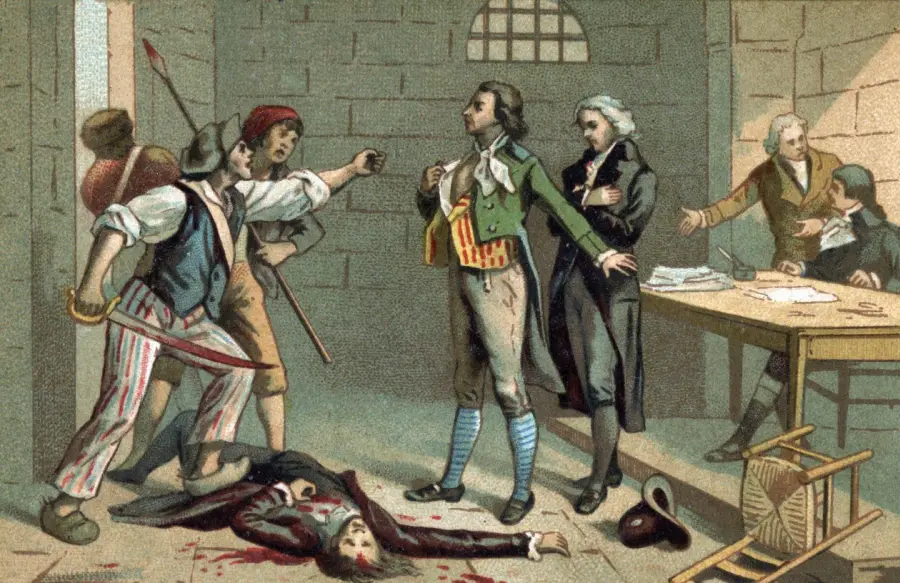
Abbe le Sicard, Director of the Institution des Deaf et Muets de Paris, being saved by Monot. Source: Meister Drucke.
Invigilators of deaf education such as the Abbé Sicard (whose main work colleague was Jean Massieu) too had fell foul of the violence in Paris. Sicard was enormously fortunate to have avoided the killing doled out during France’s September Massacres. The Abbé was one who undertook a continuation of the efforts made by his predecessor, the Abbé de l’Épée in striving to give the deaf a greater benefit by way of sign language as opposed to the oralist method of teaching the deaf to speak. Being an important educator almost did not save the Abbé:
The former Abbé Sicard. He was denounced as a moderate by a Revolutionary Committee, arrested, and forcibly imprisoned. On September 2nd and 3rd, he was included without examination among the crowd of victims destined to perish in those fatal days. Arms were already raised to strike him; when Citizen Monot, the watchmaker, rushed forward! He covered him with his body, crying out, “Stop! Friends, what shall we do?… It’s Citizen Sicard! He who makes the mute speak and the deaf hear… Strike me if you will, but spare this vulnerable man…” At these words, the fury of the would-be assassins turned to benevolence. They took in their arms the one they were about to strike and carried him home, shouting, “Long live Sicard!”
He is described as the ‘former Abbé Sicard’ because he was defrocked at some point prior to the incidents of September 1792. This was a result of France’s Dechristianisation policies. Sicard had in fact been rounded up with many other clergy (including abbots) and imprisoned at the Abbey of Saint-Germain-des-Prés in Paris during 2nd and 3rd September 1792 (according to a report written in the Anti Gallican Monitor for 22nd January 1815) pending execution. No doubt when things had quietened down, perhaps at some period after 1800 Sicard’s religious honour was restored. Thus the Abbé ran the Paris school for perhaps eight years or more as as a mere citizen rather than as an Abbott. It was only as ‘Citizen Sicard’ that the revolutionary French committees would permit him to have ‘all the leisure and all the freedom he needs to pursue his useful work.’ 1
Sicard was mentioned a number of times in a number of revolutionary publications (besides the Vedette, the Abbé was also reported in the Courier du Jour, Le Véridique ou Courrier Universel, Le Publiciste, the Journal de Francfort, Le Narrateur Universel and others). This because he was seen as a Chouannerie. As a member of the Clergy the Abbé was to all intents on the wrong side even though he greatly sympathised with the aims of the revolution.
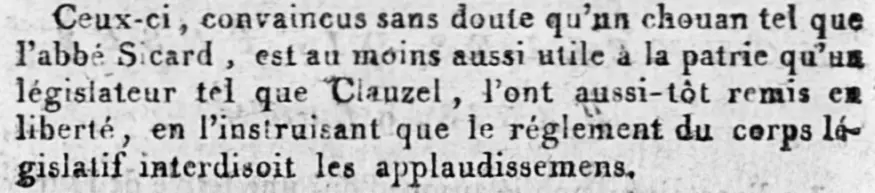
The Abbé Sicard is reported as a chouan (Chouannerie). 2
The Abbe Sicard’s life during these problematic times must have been extremely uncertain. Had the Abbé not been saved, well there’s absolutely no knowing what could have happened but more likely that the oralists would have found an easier road in terms of debasing both the deaf and the manual system, thus forcing easier assimilation into the hearing world. As it stands, the revolutionaries acknowledged Citizen Sicard as one of the great educators of the deaf – and gave him full dispensation in his work by granting him the right to continue to manage the first school for the deaf in Paris.
Jean Massieu and the thief – July 1792.
In terms of deaf history it is comforting that despite an attempted theft against Jean Massieu, the event had likely helped to save the Abbé Sicard’s life, which also ensured the manualists’ very survival. That alone ensured enormous progress to be made in terms of sign language and also prep the deaf against the eventual foibles of the doctrine known as oralism.
The focus of this article is a little known chapter in the life of Massieu. The incident occurred in the days before he became well known as a stoic supporter of the right of the deaf-mute to be educated in sign language. This was when both the Abbé Sicard and Massieu worked together to elevate the situation of the deaf. Massieu had originally been a student of Sicard’s as early as 1785 at Sicard’s school in Bordeaux, and by 1792, Massieu was working as a teacher of the deaf. Six years later he would be chief teaching assistant at the Institution Nationale des Sourds-Muets à Paris under the instruction of the Abbé Sicard. Below is a painting of Massieu with the Abbe Sicard at the school.
Someone informed Deaf21 the text at the top of the picture below in fact referred to speech. It tells how to articulate sounds through the feeling of pressure. What it is about really is even though the main emphasis was about sign language, some pupils were sent to the Institution Nationale des Sourds-Muets à Paris in the hope that Sicard could help them to speak better. Even the Abbé de l’Épée was known to have taught some of his pupils to speak too. The main emphasis of the Abbé’s work was on sign language however – because they strongly believed it to be the best means of educating the deaf.
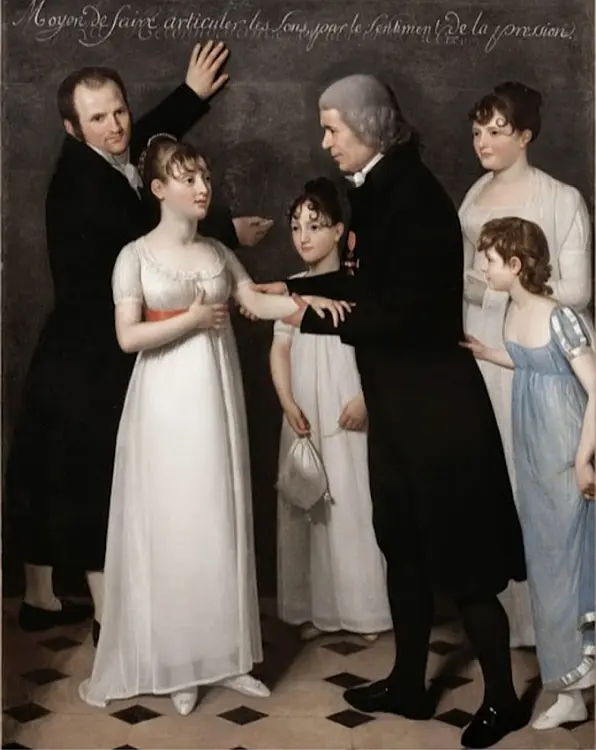
Jean Massieu (at left) and the Abbé Sicard with some of the Paris school’s pupils in 1806. Facebook.
Laurent Clerc has written about the thief and Massieu in previous works of his. Anyone who has read of the incident will have likely read it in the relevant American Annals of the Deaf and Dumb. Clerc does not give any idea of when the incident had occurred – however it was evidently in 1792.
Massieu was an important figure in the life of the Abbé Sicard, therefore he also received mention in the revolutionary newspapers of the time. A couple of examples can be seen in Le Publiciste (14 September 1800) 3 and another (30 September 1800). 4 These stories of the thief appears to be from one in particular which is the Vedette ou Gazette du Jour – however the edition in question doesn’t seem to be online.

As for the thief in question – there’s no doubt he was hearing. Massieu, being deaf, had to face not only a crime by a hearing person but also a judicial system (and a pretty messy chaotic one too) that was managed entirely by hearing people. In spite of those odds Massieu ensured his outlook on life had prevented the usual treatment given to criminals. Massieu didn’t want to see the murderous ways of the current hearing society employed as a means of justice, which is why he bravely stood against them. Anyway here’s Laurent Clerc passage on Massieu and the thief from the American Annals of the Deaf and Dumb: 5
One day he had a complaint to make against a man who had attempted to rob him of his pocket-book. He repaired to one of the Paris police-offices, and demanded a sheet of paper and wrote as follows:
Mr. Judge, I am deaf and dumb. I was looking at some- thing in a broad street with other deaf and dumb persons. This man saw me. He noticed a small pocket-book in the pocket of my coat. He slily approached me. He was drawing out the pocket-book when my hip warned me. I turned myself briskly towards this man, who being afraid, threw the pocket-book between the legs of another man, who picked it up and returned it to me. I seized the thief by his jacket, I held him fast; he became pale and trembling. I beckoned to a police-officer to come. I showed the pocket-book to the officer and expressed to him by signs that that man had stolen my pocket-book. The officer brought the thief hither. I have followed him. I demand justice. I swear before God that he stole this pocket-book from me. He, I dare say, will not deny the fact. I beg you, Mr. Judge, not to order him to be beheaded; he has not killed any one, but let him be reprimanded and I will be satisfied.
The thief was convicted and sentenced to imprisonment for three months in the jail of Bicetre.
The ‘jail of Bicêtre’ is the former hospital in the south of Paris which has been used as an orphanage, an asylum and a prison. 6 Today it is a major hospital. 7
What is of interest is even though Clerc wrote basically what had went on the overview of the case itself had been left out. Whether Clerc had seen the original article (eg that in the Vedette ou Gazette du Jour) is unknown. Nevertheless Laurent Clerc still expressed surprise that a deaf and dumb man did what he did, which was to make a case for the thief to be thrown into jail rather than face a beheading. Clearly this move exposes the classical overview hearing society generally had of the deaf – that they were dull, unintelligent, illiberal, and not worthy of any education. Its because Massieu had showed the hearing court the deaf could think beyond such limited means.
The Vedette ou Gazette du Jour (The Daily Featured News) is a collection of newspapers during the French Revolution representing both sides of the conflict. A substantial archive can be found at the University of Kentucky – however the sections concerned are not in that particular archive. Deaf21 nevertheless found a copy on Ebay!
The report in the Vedette ou Gazette du Jour may have possibly helped the Abbé Sicard in having ‘restored the deaf-mute to society’. In other words the revolution did not destroy the highly valuable work the manualists – this being those who advocated sign language rather than oralism.
The Vedette ou Gazette du Jour on Jean Massieu and the thief
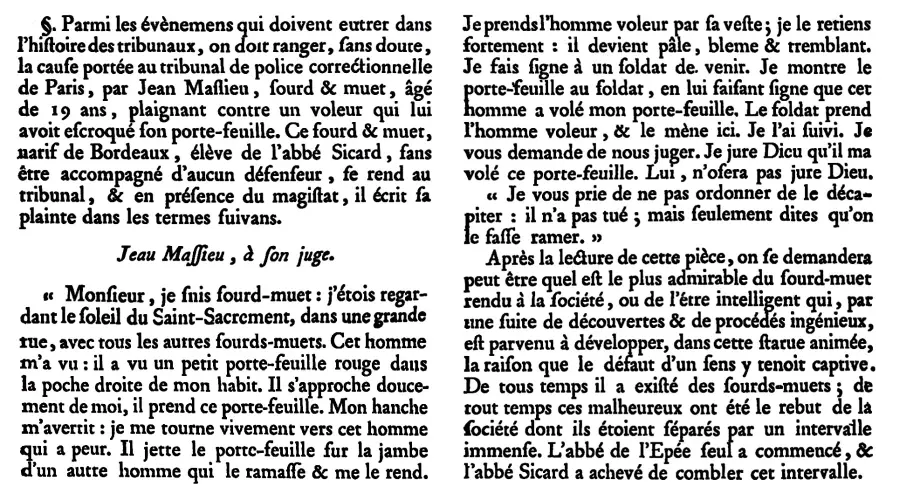
The Vedette ou Gazette du Jour for 11 Julliet 1792. Pages 5 and 6 have been combined for readability. The originals were from Ebay.
It was difficult to decide if the text ought to be highlighted. In any event it seemed better for one can instantly view the different sections, and these have borders in their country’s primary colours too. Its also a means of aiding readers in comparing both the French and the English versions. The French text is as follows:
Parmi les évènemens qui doivent eutrer dans l’histoire des tribunaux, on doit ranger, fans doute, la cause portée au tribunal de police correctionnelle de Paris, par Jean Massieu, sourd & muet, âgé de 19 ans, plaignant contre un voleur qui lui avoit escroqué son porte-feuille. Ce sourd & muet, marif de Bordeaux, élève de l’abbé Sicard, sans être accompagné d’aucun défenseur, se rend au tribunal, & en présence du magistat, il écrit sa plainte dans les termes fuivans.
Jean Massieu, à son juge:
Monsieur, je suis sourd-muet: j’étais regardant le soleil du Saint-Sacrement, dans une grande rue, avec tous les autres sourds-muets. Cet homme m’a vu : il a vu un petit porte-feuille rouge dans la poche droite de mon habit. Il s’approche doucement de moi, il prend ce porte-feuille. Mon hanche m’avertit: je me tourne vivement vers cet homme qui a peur. Il jette le porte-feuille sur la jambe d’un autre homme qui le ramasse & me le rend. Je prends l’homme voleur par sa veste ; je le retiens fortement, il devient pâle, blême & tremblant. Je fais signe à un soldat de venir. Je montre le porte-feuille au soldat, en lui faisant signe que cet homme a volé mon porte-feuille. Le foldat prend l’homme voleur, & le mène ici. Je l’ai suivi. Je vous demande de nous juger. Je jure Dieu qu’il mat volé ce porte-feuille. Lui, n’osera pas jure Dieu. « Je vous prie de ne pas ordonner de le décapiter: il n’a pas tué; mais feulement dites qu’on le fasse ramer.
The second part of the French passage is below – this being the observation that was made presumably by the publishers of the Vedette ou Gazette, looks straightforward in French – but its difficult for the translation into English. It seems translation engines can’t make proper sense of it for a couple of those gave up trying!
Après la lecture de cette pièce, on se demandera peut être quel est le plus admirable du sourd-muet rendu à la société, ou de l’être intelligent qui, par une suite de découvertes & de procédés ingénieux, est parvenu à développer, dans cette statue animée, la raison que le défaut d’un sens y tenoit captive. De tous temps il a existé des sourds-muets; de tout temps ces malheureux ont été le rebut de la société dont ils étoient séparés par un intervalle immense. L’abbé de l’Epée feul a commencé, & l’abbé Sicard a achevé de combler cet intervalle.
The above is evidently old French with a number of words that don’t exist or have a different meaning these days. What follows is the translation in English. Several translation engines were used and then also grammar check and because some of it didn’t make sense. The last paragraph made little sense in its totality, especially the first sentence with ‘dans cette statue animée, la raison que le défaut d’un sens y tenoit captive’. (There’s no such word as tenoit and tenoir doesn’t fit either according to grammar engines). That had to be changed because there isn’t a proper translation of that passage. The best has been done of this mish-mash of words. French is not even a skill Deaf21 has thus it was hugely problematic to work out what the translation and context ought to be. Even a professional translator gave some help!
Here’s the English translation. It may not be fully correct but is done in the best way thought possible:
Among the events that must be recorded in the history of the courts, one must undoubtedly include the case brought before the correctional police court of Paris by Jean Massieu, a deaf and mute man, aged 19, complaining of a thief who had stolen his wallet. This deaf and mute man, a student of Abbé Sicard, went to the court without being accompanied by an attorney and in the presence of the magistrate, he wrote his complaint as follows.
Jean Massieu confers with the judge thus:
Sir, I am deaf-mute: I was watching the sun of the Blessed Sacrament, in a big street, with all the other deaf-mutes. This man saw me: he saw a small red wallet in the right pocket of my coat. He slowly approaches me, he takes that wallet. My hip warns me: I turn sharply towards this man who is scared. He throws the wallet onto the leg of another man who picks it up and returns it to me. I grab the thief by his jacket; I hold him tightly, he turns pale, ashen, and trembling. I signal to a soldier to come. I show the wallet to the soldier, signalling to him that this man stole my wallet. The soldier takes the thief, and leads him here. I followed him. I ask you to judge us. I swear to God he stole that wallet. He, he won’t dare swear to God. “I beg you not to order his beheading; he did not kill; but only say that he be whipped.”
The conversation was done by way of written paper. The judge evidently doubted Massieu’s ability on certain morals. Massieu did not follow the sheep in condoning executions. The English text shown below is clearly problematic in translation. Even some translation engines gave up trying, so I had to try and make the best of it!
After reading this piece, one might wonder which is more admirable: the deaf-mute brought into society, or the intelligent being who, through a series of discoveries and ingenious processes, has managed to develop, in this animated statue, the reason that the lack of a sense held captive there. Since time immemorial, there have been deaf-mutes; since time immemorial, these unfortunate individuals have been the outcasts of society, from which they were separated by an immense gap. Only the Abbé de l’Épée began, and the Abbé Sicard finished, filling this gap.
What the report seems to imply is even though deaf-mutes have long been a scourge of society, there is amazement that a deaf-mute would rather ensure a thief be made to appropriately suffer the wrong doing of his ways. In a sense the general tone of the paragraph is the surprise a deaf-dumb man could even express such intelligence. To explain this a little more differently, when animated statue (dans cette statue animée) is cited it clearly means animated state. This in fact refers to Massieu’s state of being deaf. Then the reason that the lack of a sense held captive there (la raison que le défaut d’un sens y tenoit captive) clearly means Massieu (as a deaf-mute) had a lack of sense, which was no doubt elevated to a more certain intelligence by way of a flood of discoveries and ingenious processes.
This ‘surprise’ is a classic of the oralist/audist tradition. Speech is no doubt a supremacy, and those without that or hearing are indeed ‘dumb’ (no doubt even these days society continues to use that term to such an egregious extent without realising its oppressive and practically racist connotations). And for a deaf person to trounce commonly held views was most unknown. The Vedette ou Gazette du Jour’s writer evidently had a view it was not possible for deaf mutes to express such intelligence.
In 1792, and by the age of 19, Jean Massieu already had a different view of things compared to others. In 1815 when Massieu visited England he was asked numerous questions on his outlook pertaining to Government, religion, rights, wrongs, morals, and so on – and a number of the answers are surprisingly modern. Here’s his view on crime:
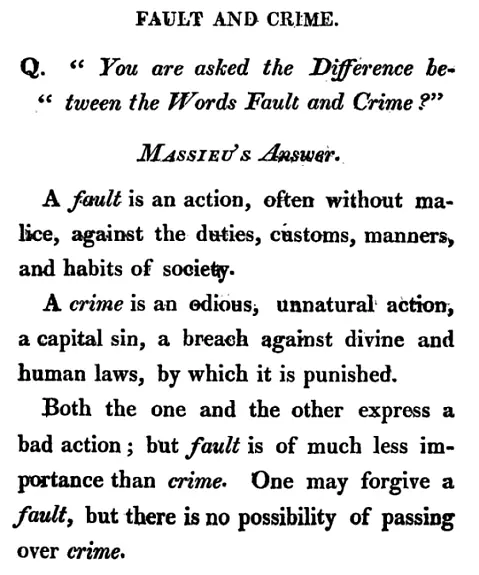
Fault and Crime.
Q. “You are asked the Difference between the Words Fault and Crime?”
Massieu’s Answer.
A fault is an action, often without malice, against the duties, customs, manners, and habits of society.
A crime is an odious, unnatural action, a capital sin, a breach against divine and human laws, by which it is punished.
Both the one and the other express a bad action; but fault is of much less importance than crime. One may forgive a fault, but there is no possibility of passing over crime.
Image of Massieu’s answer from A collection of the most remarkable definitions and answers of Massieu and Clerc, Deaf and Dumb, to the various questions put to them, at the public lectures of the Abbé Sicard in London (1815). 8
Another incident involving Massieu and a thief occurred in the summer of 1807, as reported in several newspapers including the Bath Chronicle and Weekly Gazette for 11th June 1807. This time it was the Abbé Sicard who provided the court interpretation. It was assumed Massieu would tell lies. But once again Massieu’s integrity honoured the truth.
- University of Kentucky. (2025). Le Publiciste [14 September 1800]. Available at: University of Kentucky. [Accessed November 2025]. ↩︎
- University of Kentucky. (2025). Le Véridique ou Courrier Universel, 27 August 1796. Available at: University of Kentucky. [Accessed November 2025]. ↩︎
- University of Kentucky. (2025). Le Publiciste [14 September 1800]. Available at: University of Kentucky. [Accessed November 2025]. ↩︎
- University of Kentucky. (2025). Le Publiciste [30 September 1800]. Available at: University of Kentucky. [Accessed November 2025]. ↩︎
- CLERC, L. (1849). JEAN MASSIEU. American Annals of the Deaf and Dumb, January 1849, pp.84–89. Available at: JStor. [Accessed November 2025]. ↩︎
- Wikipedia Contributors (2023). Bicêtre Hospital. Wikipedia. Available at: Wikipedia. [Accessed November 2025]. ↩︎
- Hôpital Bicêtre. (2016). Hôpital Bicêtre. Available at: Hôpital Bicêtre. [Accessed November 2025]. ↩︎
- de, L. and Sievrac, J.H. (1815). Recueil des définitions et réponses les plus remarquables de Massieu et Clerc, sourds-muets, aux diverses questions quileur ont été faites dans les séances publiques de M. l’Abbé Sicard, à Londres : auquel on a joint l’alphabet manuel des sourds-muets, le discours d’ouverture de M. l’Abbé Sicard, et une lettre explicative de sa méthode. Gallaudet University. Available at: Gallaudet University. [Accessed November 2025]. ↩︎
This post was originally published November 2025. Its formatting has been corrected and the layout is cleaner. The text is substantially revised and new images are added.