Physical oralism
The M4 motorway goes from London to South Wales. As their car travels westward, our unnamed university academic is sure to be playing songs like ‘Ten Years Gone’, ‘Trampled Under Foot’ and ‘Sick Again.’ Not forgetting Dazed and Confused – ‘Lots of people talkin’, few of them know’ how it is to be deaf under an oralism regime. Quite apt these songs and their titles! Evidently this university academic wanted to know more about the sufferance the deaf had endured. Was it a sort of physical graffiti the hearing had imposed upon the deaf? Our academic wondered, then thought further, ‘well at least those Led Zeppelin song titles most definitely convey the feeling the deaf get when faced with an oralism regime.’ Our university academic leaves the M4 at Junction 13 then takes a bit of country road before reaching a place where oralism was mightily celebrated, having survived exactly eighty years under its present namesake.
To cut a long story short, oralism has been an insidious doctrine. As our university academic had found, oralism had often involved the physical – such as implements being shoved in one’s mouth, children getting whipped for not being able to communicate properly, pupils having to sit on one’s hands whilst they are forced to ‘speak’, having hands stretched out had whacked because one wanted to resist speech. And then there was Milan 1880. Sign language banned, deaf teachers sacked and the rest of it. In the meantime Alexander Graham Bell (a hero of the hearing world who wanted to vanquish the deaf, but let’s not forget he was a racist and a eugenicist too), had claimed the deaf would form a threat to society. And the Nazis’ drive against what they deemed ‘defectives’ began with the deaf first.
Our university academic learnt that many schools had instigated punishments for using sign language, but this particular one went along a different route and rarely used punishment. Instead it held a competition. Those who gained the most skill in speech would win awards – a means of enlightening pupils in the importance of learning to speak – and ‘speech’ points were given. The harder one worked at it, the more likely they would win awards. There were ‘Speech Days’ where prizes and awards were given.
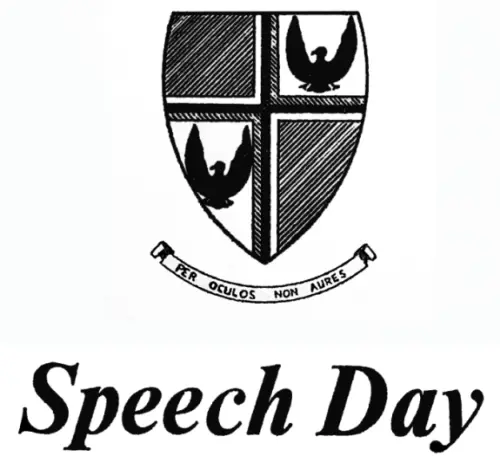
The cover of the Speech Day programme!
The head honcho of this particular educational establishment claimed the manual system of education was an outdated system that belonged to the 18th Century. It was claimed that led towards an isolated and deprived sub-culture. That’s something along the lines of what Alexander Graham Bell and other early oralists had arrogantly concluded. This school principal bemoaned the fact the Department of Education had a focus upon sign language instead of the oral method. Very strangely the school’s very own motto – per oculos non aures – translates as being ‘through the eyes, not the ears.’ Or more idiomatically, ‘by sight, not by sound.’ Surely that should have been in celebration of sign language and not the oral system. Totally weird!
One can see from the assertions this education head was making no doubt indicates a shift in focus had been made from the much maligned oral method towards sign language. This does reasonably tie-in with what was known at the time – that many education establishments were realising the futility of the oral method and reverting to sign language. Another major shift at the time (early to mid sixties) had been made by way of Carl Croneberg, William Stokoe and others who identified clear evidence of a deaf culture and its sign languages.
The school head claimed a re-emergence of the manual system would force schools like that he presided at, to close, because everyone would flock to schools that offered the manual system instead. He bemoaned that fact there were just 13 schools of the 45 deaf schools extant in the UK which used the oral method. The following passage is from the Newbury Weekly News a good many decades ago – the year being 1971. But first, here’s the newspaper’s headline:
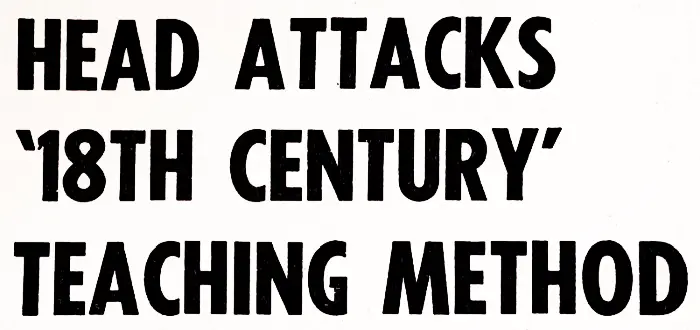
Now we know what this is going to be all about!
And the attack begins…
THE PRINCIPAL, Mr. R. Askew, in his report, hit out at a “drift back into the 18th century” in the methods of teaching deaf children adopted in many other schools in the country.
Instead of using oral and aural methods of teaching like Mary Hare does, many schools had reverted to manual media.
He said “We use speech and trained listening where there is any residual hearing whatsoever and the successes achieved can no longer be denied. Nowhere in the world can comparable results be found based on the non-oral methods of finger-spelling, signs or a combination of these with speech.” Mr. Askew referred to a survey carried out by the Department of Education and Science into the use of signing and finger-spelling in schools for the deaf in this country – a survey which did not include Mary Hare Grammar School.
It found that out of 45 schools only 13 used oral methods, the others having reverted to the use of manual media.
He went on “We have the accumulated evidence of many years in our entrance examination records that the language attainments of 11-year deaf children correlate closely with oral methods of teaching. It is rather appalling that that this school might run out of pupils because no-one in authority appears able to stop this drift back into the 18th century. It will be a major calamity for the deaf if – because they are dependent upon an esoteric of communication – they are thrust back into the isolated and deprived sub-culture from which we are trying to rescue them.”
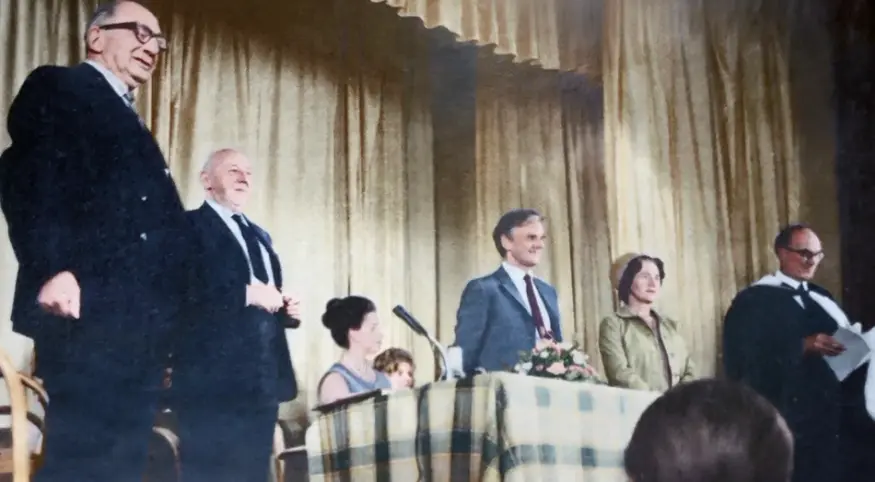
The school’s overseers look across the many ‘oral successes’ before them. Preventive action against what are deemed ‘deprived sub-cultures’ is their very modus. Evidently they do not know what their very own hearing world is like for the deaf and the many means its has used to marginalise the deaf. Clearly these oralists are unable to see their own boots!
The school’s claim to being a ‘grammar’ was dropped in the winter of 2002. It now allows some sign language, such as at special lectures/occasions, as well as out of school time. Its main focus is still oralism of course. Evidently, as our university academic had found, it was still a case of ‘the Lady’s not for turning!’
Our university academic headed back on the motorway to London to write their findings on this school. They looked back in their rear mirrors and hoped that Newbury, Junction 13, and this establishment that sat on a hillside overlooking the countryside would not ever show in their lives again. They had concluded one thing already – oralism is an absolute nightmare!