Pictures in the Mind
Joyeux Noël! Pictures in the Mind is a documentary made in 1987 based on Harlan Lane’s ground-breaking book When the Mind Hears – a volume of almost 700 pages (US editions) covering the comprehensive history of the oppression of the Deaf. Until that time few programmes were indeed made for the Deaf. Even Vision On which had set out with a Deaf BSL presenter soon saw replacement with hearing presenters. Thus it wasn’t just education but also national media representation where the Deaf were being hidden from the public. Essentially a period of around ten years saw barely any Deaf on television and it was not until the 1970s that new opportunities arose and the Deaf slowly began to be represented on television and in printed media – and largely free the heavy hand of oralism.
Pictures in the Mind portrays a history of deaf people which is alien to most parents and teachers of deaf children. It will shock some and anger others. (Times Educational Supplement 3rd April 1987, page 39).
The film Pictures in the Mind came about because of a collaboration between Channel Four and Souvenir Press for the UK launch of Harlan Lane’s book – the former by making Pictures in the Mind and the latter by organising a series of seminars hosted by Harlan Lane. These featured as a tie-in with the first ever British edition publication by Souvenir Press of When the Mind Hears. The series of seminars consisted of talks in Durham, Leeds and London, as well as two hour long BBC See Hear specials. Channel 4 played an additional role in the publicity by having Harlan Lane present one of its ‘Comment’ editions – a short 10 minute programme that regularly aired a topic of current interest. That plus Pictures in the Mind were shown on the same day – the biopic at 6pm and the comment at 7.50pm following the main news.
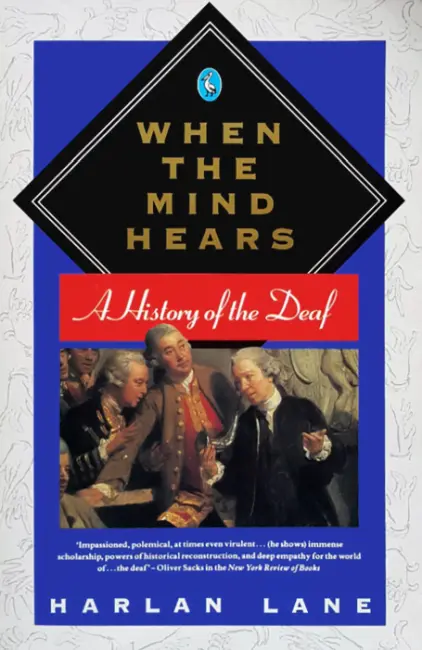
When the Mind Hears. Harlan Lane. The first British editions were Souvenir (hardback, pub. February 1987). Pelican (paperback, September 1988).
The film’s main theme had espoused a notion that Deaf people viewed themselves as lacking intellect – this because the oralist educators, through their own stupidity, had been quite unable to see the shortcomings of their abject system. Towards the end of the film The Boy (David Portsmouth), after a journey through history learning how the oral system had promoted what amounted to a lie, is told ‘Its better that you should know all these things. Or you’ll be like most deaf people, going through life believing that your problems were due to you being stupid. When in fact your life has been shaped by the stupidity of those in charge of your education.’
Pictures in the Mind featured Doug Alker as The Magician, the show’s main character who takes David Portsmouth on a tour de force through the annals of Deaf history in order to demonstrate why the Deaf had been given a bad deal. Doug was well known for his work in the fight for Deaf rights, including a number of BSL Rights marches during the 1980s and 1990s, as well as setting up campaign groups such as the 1880 Committee and the Federation of Deaf People, not forgetting his 10 year stint as the first ever CEO of the RNID. Paddy Ladd also had a substantial part performing the historic character Jean Massieu. The film was made in the days of the National Union of the Deaf (NUD) before he became internationally famous following his work at Bristol University and the publication of his book Understanding Deaf Culture: In Search of Deafhood. The NUD’s aim was to ‘restore the rights of the Deaf’ and the previous year (1986) had seen campaigns in the UK against cochlear implants and a continued emphasis on oralism. Pictures in the Mind was no doubt one of the early efforts ‘to use TV, Radio, and Newspapers to explain to the hearing world the ridiculous way that our children are being treated.’ (NUD campaign document 1976). Pictures in the Mind and When the Mind Hears no doubt set Deaf people thinking – the following year in America Deaf people were seen at their best when it came to the Deaf President Now campaign – and that because there was a greater awareness of the menace of oralism. Pictures in the Mind had indicated it was the Deaf who were in charge of their destiny and not the hearing. And the worldwide images generated by the Deaf President Now campaign clearly showed that to be the case.
Jumping back in time a decade or so, it was about the same amount of years beyond the early history of Vision On when its first Deaf presenters had been substituted in favour of hearing ones, when the 1970s saw Deaf issues on the rise once again. BBC TV’s ‘Open Door (1973-1983) first featured ‘One in a Thousand’ (1974) which highlighted the ridiculous advice given on Deaf children by doctors, teachers and administrators. Around that time the regular BBC 2 magazine ‘News Review’ (with Bill Northwood) began using subtitles and occasional signing. Open Door once again featured sign language when the National Union of the Deaf presented ‘Signs of Life on 10th May 1979. That was an excellent programme and many Deaf hoped it would be the start of something more substantial – a regular weekly programme for the Deaf which we all know now as See Hear! On September 1979 the BBC broadcast its first ever live subtitled programme, and this was soon followed by See Hear! from October 1981.
Pictures in the Mind took things further by being the first ever to feature Deaf actors and BSL in the format used. The announcer at the start of the programme said it was ‘a drama-documentary about a century old battle concerning sign language for the deaf. Its the first drama-documentary ever made in this country with Deaf actors using sign language, using pictures in the mind.’
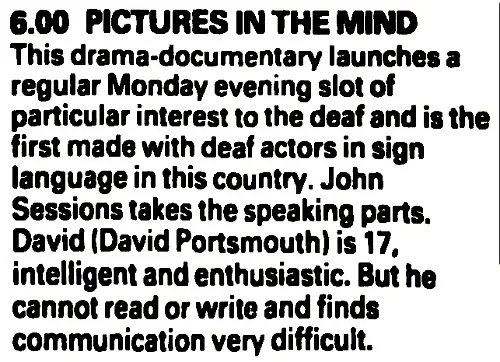
Pictures in the mind – typical entry for the TV listings 6th April 1987.
Pictures in the Mind was shown on 6th April 1987 on Channel 4. Based on Lane’s book the film involved a mix of modern storytelling and events related to both the life of Jean Massieu and Milan 1880. There basically has never been a drama-documentary production on the scale of Pictures in the Mind since, which sadly shows just how far things have progressed this past forty years! Its not to say there have not been any exemplary productions since. There was The Count of Solar which too used a cast of Deaf actors and notable leading hearing actors and it too involved substantial sets. It might be wrong to say this however the quality of the productions beyond these two films has not really been the same.
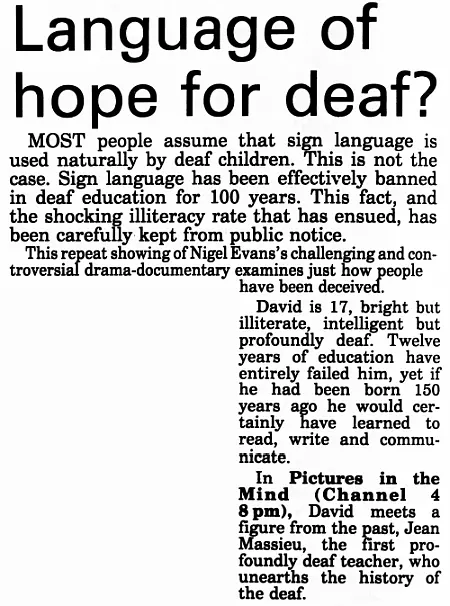
The Shropshire Star for 31st March 1989 reviews Pictures in the Mind ahead of its repeat showing that same day.
Pictures in the Mind was broadcast a week later on S4C 11th April 1987 – that also meant Deaf viewers in the eastern part of the Irish Republic could see the programme too. It was repeated on 31st March 1989 (a number of TV listings in several newspapers for that day do indicate there was a second showing of the film in several TV regions). Pictures in the Mind has not been repeated since March 1989 as far as is known.
While the documentary and the book both cover very similar themes, they are certainly distinct differences between these. Lane’s book provides a detailed, authoritative historical statement of the events that led up to the Milan Congress of 1880, while the film offered a visual narrative based loosely on some parts of the history described in Lane’s book.
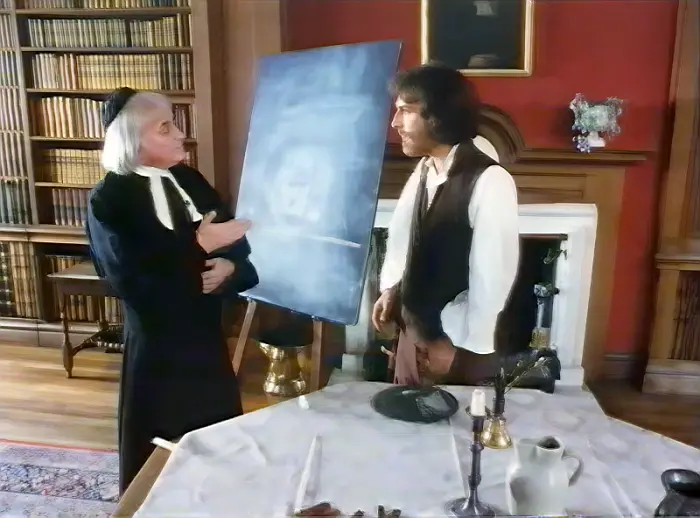
The Abbé Sicard (Edward Jones) and Jean Massieu (Paddy Ladd) in a scene from Pictures in the Mind (1987).
Who was Nigel Evans, the programme’s writer and director? Evans was a scriptwriter/producer renowned for a number of documentaries highlighting the plight of the disabled and other topics. More than forty documentaries were made and these include ‘Silent Majority’ and ‘Walter’. Pictures in the Mind was the first drama-documentary filmed entirely in sign language.

Nigel Evans during filming for a documentary in 1992. Wikipedia.
Channel Four’s existence is no doubt down to Nigel Evans for without him we would have not have had Pictures in the Mind, Silent Majority, the History of Psychiatry and The Madness Museum. Not forgetting the channel’s two successful Deaf news and topical TV productions Listening Eye and Vee TV. In 1980 Evans had became part of a lobby group dedicated to establishing a fourth UK TV channel with a remit largely on independent producers who preferred innovation, experimentation and creativity for a culturally diverse society and this is how Channel 4 began. For his part, Nigel Evans produced a considerable number of productions featuring the disabled, psychiatry, racism and other issues.
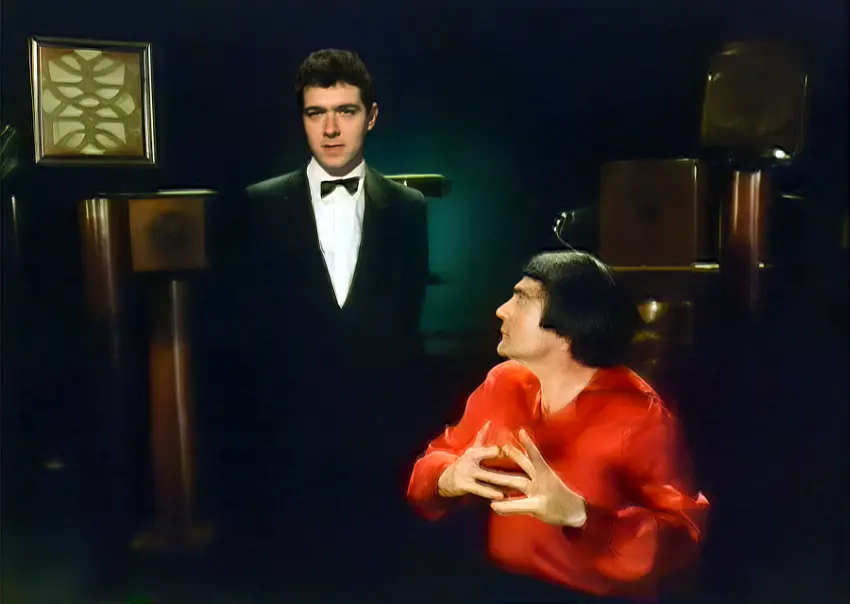
John Sessions, a renowned comedian and TV actor who certainly put in a most notable effort (with a good sprinkling of sarcasm) as the chairman of the controversial Milan Congress – indeed it was a total rarity to see a truly batshit oralist played with great aplomb! There’s no doubt this particular role was intended to reflect that of the Abbé Giulio Tarra who had been the Milan conference’s actual chairman. Screencap from Pictures in the Mind enhanced and upscaled by Deaf21.
Besides oralists who had no clue what they were waffling on about, Pictures in the Mind also features this real life hearing/speech specialist who doesn’t know what he is talking about either (like so many oralists) especially when he claims some deaf have been brought up by gazelles! This is a gross historic error and does not reflect the true situation of those circumstances. Evidently those claims he made are a gross distortion of the Wild Boy of Averyon story.
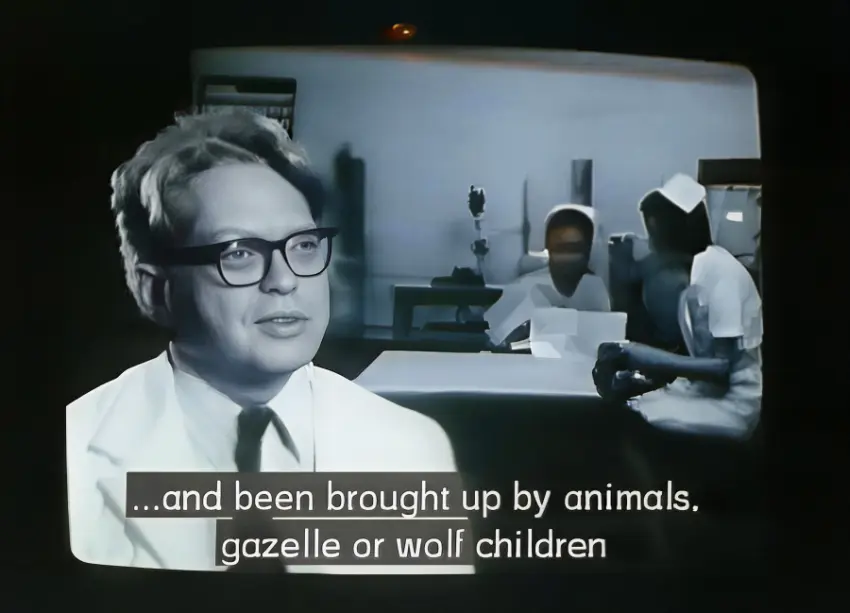
Doctor says some Deaf children had ‘been brought up by animals, gazelle or wolf children.’ The full transcript is below:
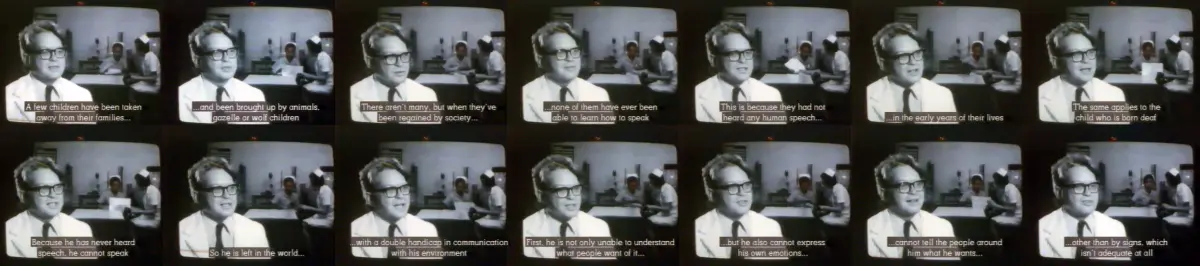
A few children have been taken away from their families and been brought up by animals, gazelle or wolf children. There aren’t many, but when they have been regained by society, none of them have ever been able to learn how to speak. This is because they had not heard any human speech in the early years of their lives. The same applies to the child who is born deaf because he has never heard speech he cannot speak and so he is left in the world with a really double handicap in communication with its environment first of all he is not only unable to understand what people want of it but he also cannot express his own emotions, cannot tell the people around him what he wants other than by signs, and this of course isn’t adequate at all.
One of the sobering things about Pictures in the Mind was even though it was a tome about the oppression of the Deaf, the issue of hearing control in fact showed up in the film too as clear evidence of the control the hearing had over the Deaf. Throughout the film one can see regularly the sign for hearing used with a thumb. This meant the hearing were good – and insinuated that being deaf was bad. Eventually this sign was deemed irrelevant and replaced with the index finger to denote hearing. Not only that the sign for deaf/dumb was also used. That would not be acceptable these days. For nearly a hundred years the Deaf had used those signs because they lived in a hearing system and it was that system which basically dictated the signs that could be used – and these basically denoted the Deaf were of lower intellect than the hearing.
The film’s use of magic to highlight the issue of Deaf oppression
The first ten minutes or so of Pictures in the Mind is a means of introducing the viewer to what had at the time had been a little known matter – the coercion and oppression of the Deaf. The film opens with a mysterious London Underground setting involving Doug Alker and Jean Massieu. The latter is evidently a reminder of a past that had been once possible for the Deaf when a promising future (as revealed later in the film) was practically smashed to bits by the oralists and their insidious Milan 1880 Conference of the Deaf.
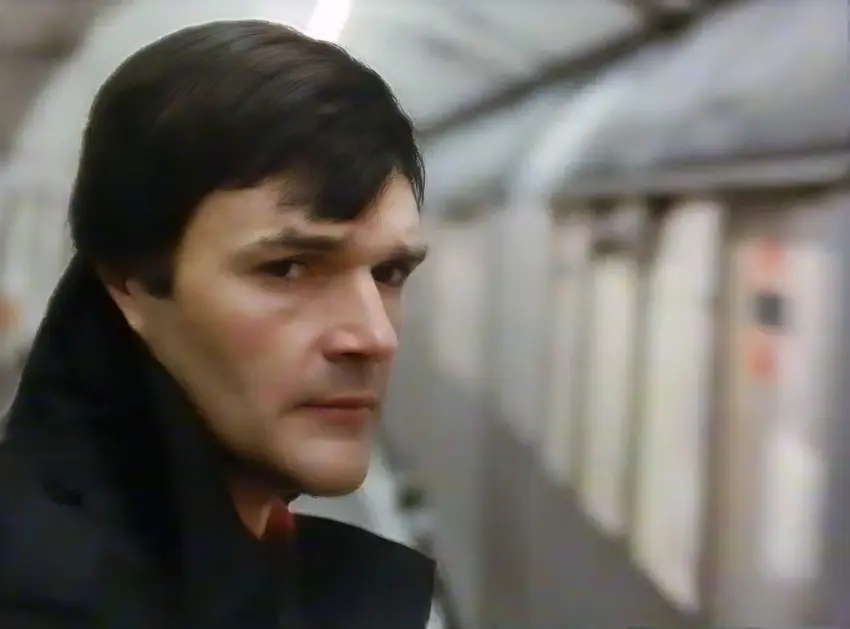
Doug is puzzled somewhat when he spots the apparition of Jean Massieu at a London tube station.
Doug Alker is somewhat taken by Massieu’s presence as he makes his way to Covent Garden to perform one of his magic shows. Following this are quite everyday scenes at Covent Garden plus Alker performing his magic to the discerning public. One of the tricks include extracting a string of razor blades from his mouth! In a sense that trick denotes the essence of oralism. What came out of the mouth was (metaphorically) very cutting stuff, which no doubt was what oralism (and Milan 1880) was about. A poison issuing from the mouth and clearly directed against the innocence of the Deaf community struggling to make sense of their position in the world.
The next magic scene involved Doug being tied up by David Portsmouth. After an instant Alker had freed himself from this seemingly impossible tether. Again this was a subtle reference to oralism (and indeed Milan 1880). The oralists desired that the Deaf be tied up and tethered to an aural system – with the odds stacked completely against the Deaf – because evidently speech was a supremacy and there was little the Deaf had in terms of fighting this insidious doctrine.
Indeed many Deaf children had their hands either tied up or were forced to sit on their hands. This was to stop them from using sign language or indeed any sort of gesture. It was an abject form of torture devised by the oralists. Oh how it would be to be free of this insidious doctrine!
And that is what Doug manages to do! He frees himself of the ropes. Having magically untethered himself to the applause of his Covent Garden audience, its clear this magic was also symbolic. How beautiful it must be to be free of the oppression from those who spoke and hear and to live one’s life as one would have wanted – a full 100% Deaf person with no desire for a need to hear anything nor parrot that thing called speech.
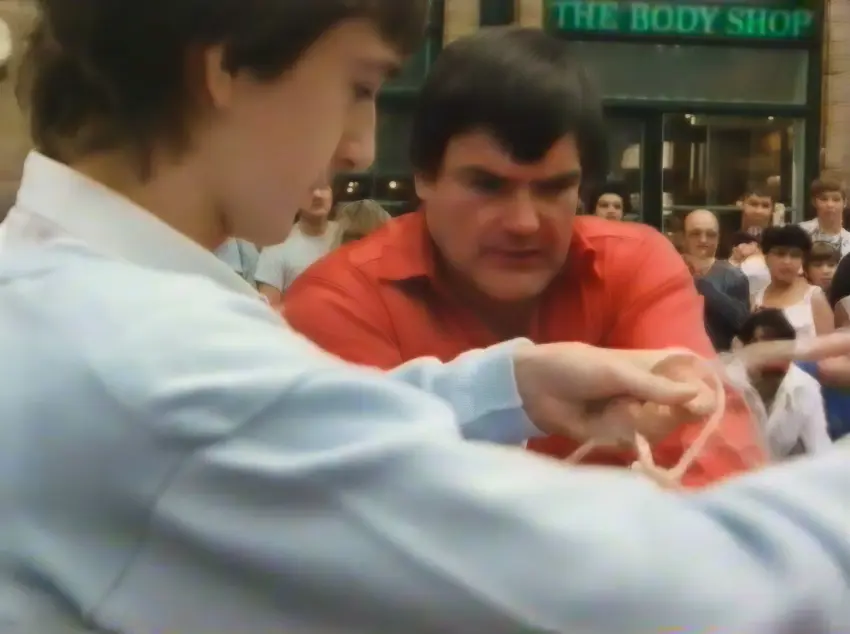
Doug’s rope trick with David Portsmouth. Oh to be free of the oralist and audist shackles – and yearn to become more enlightened!
Up to this point neither Doug nor David had introduced themselves and seemingly the audience at large had not known that either were Deaf too. Its important this because very often the Deaf have to not make themselves known. Because if they had done, hatred, ridicule and scorn would easily be forthcoming. The crowd at Covent Garden could have quite easily turned on the two with great anger. This has long been the situation of the Deaf. A sort of ‘forced’ (compulsory even) hearing face in public because the iron fist of oralism and audism presented an ever continuing danger which at times involved violence because those with speech undoubtedly saw it as a given that they alone could dictate how the Deaf lived and existed. In a sense it was an enforced perpetuity which in part amounted to this existential feeling of being devoid of intelligence.
At the very moment Doug is seen setting up a small table to advertise and demonstrate his magic emporium, this is where both he and David come to realise – and confirm – that both are indeed Deaf. However David feels he is the one who is less enlightened than Doug and that because he can’t read. Thus Doug sets out to show David the history of the Deaf and this is where the script takes up the themes detailed in Harlan Lane’s book When the Mind Hears. Doug explains to David how he himself came to assert his own identity first and foremost as a Deaf person. Jean Massieu briefly appears and this is the indication that both need to dig into the past to find out just why David has this sheer confusion and uncertainty over his own identity as a Deaf person.
Below is the video Pictures in the Mind from 1987 which was an important documentary detailing the historic oppression and coercion of the Deaf. The quality is 480p sadly. The episode would have been recorded on VHS (in itself not exactly a brilliant quality) thus the transferring from that to digital would have seen further degradation in picture quality. I also recorded Pictures in the Mind and have it on VHS but my copy is definitely worse than this one that’s available on Youtube!
Video – Pictures in the Mind (1987)
The film has in-vision subtitles and its best viewed as it is with those subtitles. Automated Youtube subtitles have been added because these are intended to help with the pacing of the film as well as pick up on things the voice over says that isn’t reflected in the original subtitles. or for those who need a more clearer and legible subtitling (such as the Deaf-blind or those with Usher) – and that because the original subtitles are done in a style that wouldn’t even be considered visually optimal now. Also in that respect its hoped the Youtube generated transcripts will help too. The original Youtube film version shows extraneous advertising plus CH4’s Evening News included and it did not have the film subtitled either. Hence the above edit shows the film solely with subtitles for anyone who may require these. Being auto generated, these Youtube subtitles in the film above have the inevitable inconsistency – among the usual subtitle glitches they can’t spell for example Gallaudet’s, nor Massieu’s or Sicard’s names.
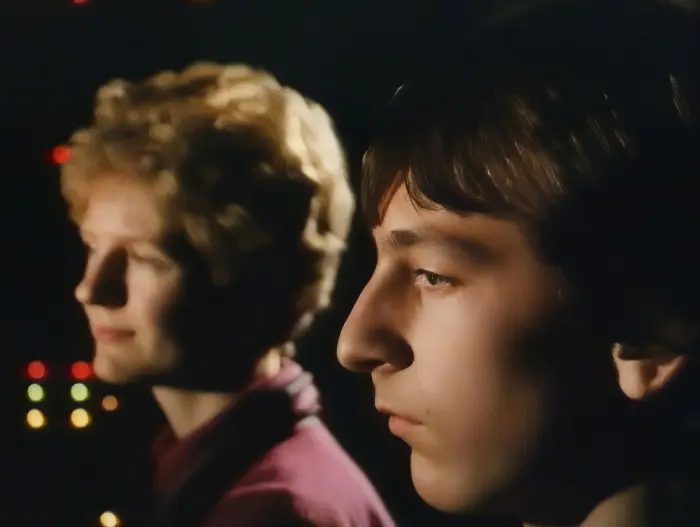
Emma Tumim and David Portsmouth. Pictures in the Mind.
The film’s locations
Parts of it were filmed on the London Underground. The scenes with the long tunnels containing archived material were filmed at one of London’s deep level tube shelters – possibly that near Tottenham Court Road. The lift scenes were filmed elsewhere as those at the deep level tube shelters were far too small to film in. The tube station scenes at the start of the film were shot on the Central Line at Lancaster Gate. The central London scenes with Doug Alker doing his magic were filmed at Covent Garden. Interestingly Doug was one of only two Deaf magicians who became a member of the famous Magic Circle.
Those in the film were (in order of appearance):
Doug Alker (The Magician)
David Portsmouth (The Boy)
Paddy Ladd (Jean Massieu)
Edward Jones (Abbé Sicard)
John Sessions (Milan 1880 President)
Emma Tumim (herself)
There was an uncredited appearance by Linda Day – the Deaf mum to a young Deaf child whose development and knowledge through sign language was contrary to what many oralists had claimed – that this could only be achieved through the learning of speech.
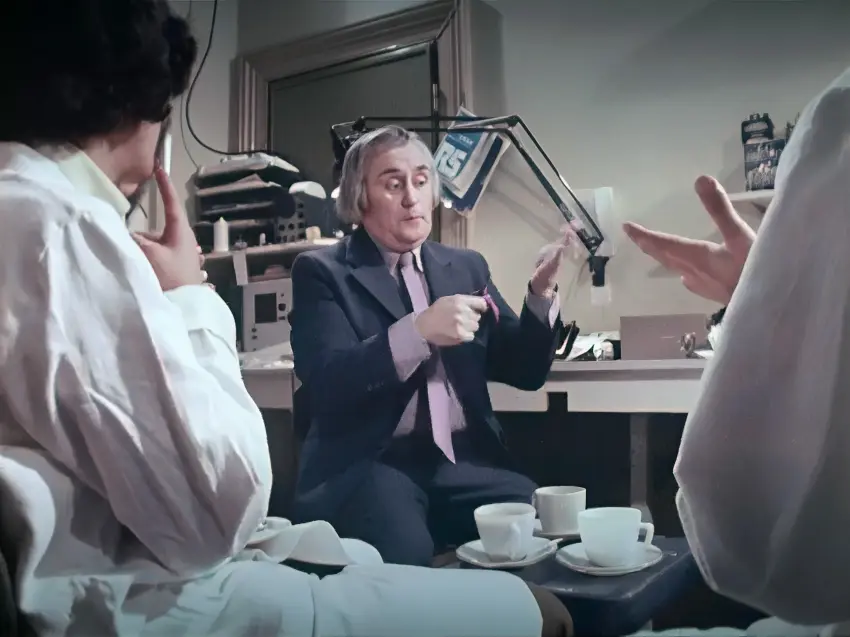
Edward Jones (credited as Sicard but spelt wrongly as Sichard) was an interpreter – he is seen here in a Horizon programme from 1973!
For those who are interested, Gallaudet University holds archives related to Pictures in the Mind including correspondence and film scripts.
The feature image (and that used for the video) are of Doug Alker riding the tube train at the start of the film and reimagined as a sort of psychedelic imagery. This was in fact used by Channel 4 to highlight that Pictures in the Mind would be the next broadcast to be shown, after a few minutes of advertising had first been shown. This image has been expanded somewhat so it shows more background than the original did. All the other images are upscaled versions and a couple had to have the faces rebuilt using other images because the quality was so poor.
In memoriam of Doug Alker. 1940-2025.