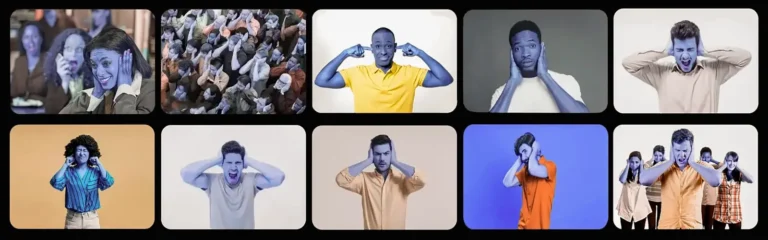
Is speech not of hearing people?
As a deaf person I have sometimes asked of hearing people whether they do know if they are intentionally speaking or not. In short, are they conscious of every single word they utter? And the answer, not always, is they do not. Its something that’s actually been known since ancient times, but in terms of today’s climate it is even more important – especially when deaf people are at the behest of hearing people who insist ‘X’ or ‘Y’ about them, such as accusations, assertions, claims – or what amounts to things that are lies and mistruths.**
What is said or spoken is essentially not of a hearing persons’ own making. Basically they have little clue what they’re waffling on about. With the emergence of Trump and a number of other insidious speakers and not forgetting things like Youtube videos (such as interactions with the police, auditing videos, first amendment videos and so on) where arguments and confrontations can be easily observed by the deaf and practically every word understood by way of subtitles. It is clear in many of these videos the talking extends into what can only be sheer fantasy territory. In other words many hearing people don’t have a clue what they are talking about – not even the police!
The prevailing view among scientists for how speech works in the human brain is that it’s planned in advance — consciously thought out — and then executed, or spoken. But some cognitive scientists have suggested that speech is only partially planned, that part of our understanding of what we say comes from our hearing ourselves speak. In other words, speakers often don’t truly know what they’re saying until they’ve already said it. (Science News – You don’t really know what you’re talking about).
It appears speaking is not actually of the mind but ‘resides’ there and makes its own decisions. Thus talk is not really a person’s own – but rather the output of some sort of thing living inside their mind! There’s a very important discussion going around in the hearing world (except they don’t look at it from a perspective of oralism/audism) regarding Large Language Models. These ideas are examined in a video shown below – ‘The Terrifying Theory That Your Thoughts Were Never Your Own’.
Curt Jaimungal filmed two academics – cognitive scientist Elan Barenholtz and theorist/lecturer William Hahn in order to unpack a claim which looks like science fiction – but has potential to be science fact – especially if what is being claimed is true. Language is a self-generating organism that installs itself in someone’s brain, it runs there as ‘software,’ and uses a person’s mind as the hardware.
We begin sentences without knowing how they will end. We commit to grammatical paths and backtrack when they fail. We are sometimes carried somewhere unexpected by the logic of what we were saying. (Elan Barenholtz – language does not describe reality).
The video, subtitled ‘Language is an alien parasite’, presents a new perspective on language. The academics argue that spoken language is an autonomous informational system. It runs within a person’s brain quite independently of any other sensory experiences. The reasoning behind this is Large Language Models (such as ChatGPT) have revealed certain properties of both language and cognition and that offers a radical shift in how human thinking and knowledge is understood.
One wonders whether the academic speakers – Barenholtz and Hahn – even know what they are talking about! Maybe its that they have an idea of what to say – but don’t actually produce the words about to be spoken? Its something that has been questioned for centuries and yet until now, no-one has been able to understand what is happening. But for the first time the ‘ghosts in the machine’ is on the way to being understood better.
The Terrifying Theory That Your Thoughts Were Never Your Own video is one where one can understand certain aspects of spoken language and its influence on thought processes. The ideas are derived from Large Language Models (LLM) – which involve what is known as an autoregressive prediction of tokens. Basically how LLM’s work is these generate human-like text by predicting the most likely next token (a word, part of a word, or character) based on the context provided. A very simple example would be ‘The cat sat on the …’ The easy answer to that is ‘mat.’ Another simplistic example would be ‘the weather is nice isn’t it?’ The reply is ‘oh its absolutely fantastic!’ What it means is there’s an implicit structure in speaking and one does not even need to know it. Its a ‘token’ that aids the structure and lexicon of everyday speech.
The ideas in the is video are quite bold. They claim language is an autonomous informational system which runs in peoples’ brains, and feeds on patterns that produces streams of words, both in speech and inner monologue. It is “downloaded” into one’s brain from infancy. When one speaks, an internal language model is running and this is how spoken language is created.
Elan Barenholtz thinks the whole picture of language to date has been wrong. When someone asks, ‘What did you do last summer?’ one’s brain begins to generate a narrative in real time. ‘What did I do last summer? Well, I went to…’ and it runs on from there. Its why LLMs can answer such vast ranges of questions without having a database of everything. They hold an enormous space of potentialities, and that is pretty much like how humans work too.
If Elan Barenholtz and Will Han are even somewhat right in their reasoning, the voices in one’s head, the flow of hearing people’s speech, and many deepest beliefs are not purely someone’s own thinking. They are basically information systems that took root in one’s mind long before they even got to say these things.
In terms of biology, speech might have started off as rough grunts and sounds, before forming distinct and self-sustaining patterns that are a feature of everyday language. However this could be about to change because the development of LLMs and autoregressive prediction tokens means that people could instead learn to see their own thoughts/speech as having derived from an inner language model that’s largely influenced by family environments, cultural upbringing and social experience.
**Its not to say that deaf people don’t lie. Rather its about when being spoken over or misappropriated by hearing people, its about knowing what to say in response or to challenge any fallacies or assertions that might be said. Evidently the downfall in all this is the age old chestnut – which is how does one, as a BSL user, even begin to challenge a hearing person? The gunning act of speech is the problem. If one tries to say something simple as ‘that is a lie’ (in signing or by lip-reading) the hearing person will often respond with a huge flow of words and assertions (and a few other hearing probably brought into the fray as a means of enforcing further bias), there’s so little which one, as a deaf person. will easily make sense of, but the idea is that by them (the hearing people) ‘knowing’ what they are saying, they might say, ‘I’ve told you once, twice now, and I’m telling you again….’ They don’t care whether the deaf person has understood or not. Evidently the modus being demonstrated is they have the upper hand and one, as a deaf person, has absolutely no defence of any sort. Its classic audism.