Glyndon
Glyndon is a place named after a Deaf person. Its a rarity that a town gets to be named after a Deaf person. Very few places in the world have that honourable distinction! Glyndon is in Minnesota and located some 260 miles west of St. Paul, is named in honour of the deaf poet and journalist Laura Redden Searing, who also wrote under the pseudonym of Howard Glyndon.
Glyndon is located in one of America’s most significant northern tallgrass prairie sites. This is largely represented by the Bluestem Prairie Scientific and Natural Area (SNA) owned by the Nature Conservancy. The land is a remnant of the native prairie that once covered most of the region.
The water tower at Glyndon, Minnesota. Google Streets.
Originally a railroad community, Glyndon (population 1,306) was named by those who had admired the patriotic poetry that Laura Searing had wrote during the American civil war. It has also said that a number of Northern Pacific officials either knew or were themselves related to Deaf people, thus it was thought the new township should be honoured with the name of a Deaf person. Searing became deaf at age 12 due to meningitis and went on to have a prominent career, writing for publications like The New York Times.
Glyndon was founded in 1872 originally as a staging post for the Northern Pacific Railroad. These days the line belongs to the BNSF Railway. In 1876, the railroad constructed a reception house adjacent to its station to accommodate immigrants, mainly Scandinavian settlers, who had arrived by train and this established Glyndon as an important place for that purpose.
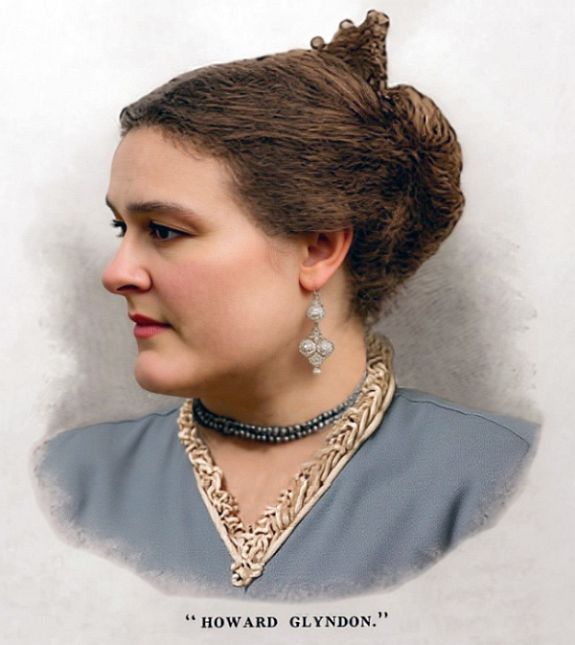
Howard Glyndon – aka Laura Redden Searing circa 1883. Picture from an Ebay image and cleaned up/colourised by Deaf21 to represent her photographically. (Compare with this image on Wikipedia).
As the writer/journalist Howard Glyndon, Laura Searing got to know a few famous people, including General Ulysses S. Grant and Abraham Lincoln himself. Lincoln, who was US President from 1861 to 1865, bought her books including Idylls of Battle and Poems of the Rebellion (1864). Laura Redden gets a special mention for the sake of posterity in Harlan Lane’s When the Mind Hears.
Any discussion of deaf poets must mention… the noted literary patriot Laura Redden, who lost her hearing at age eleven, attended the Missouri school for the deaf, then published poetry and journalism under the pseudonym Howard Glyndon. Her interviews with Lincoln, several famous generals, and elected officials whom she counted among her friends were widely read, as were her war poems… her poems and stories… appear in Harper’s the Atlantic Monthly and other magazines. (When the Mind Hears. Harlan Lane, 1984, P247).
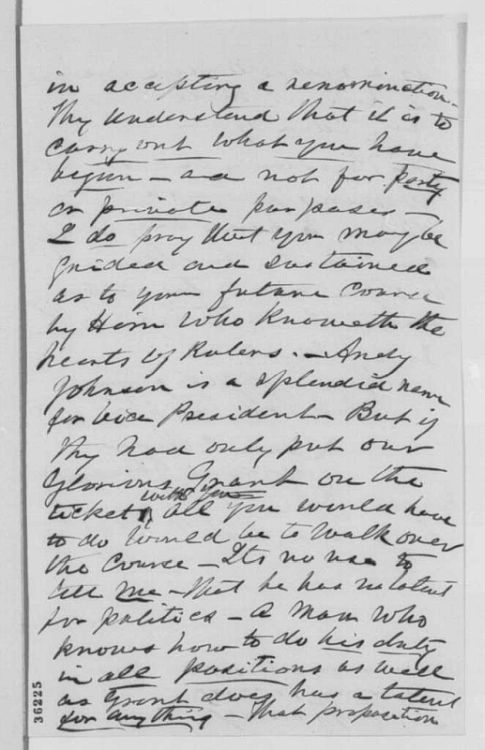
Laura Redden to Abraham Lincoln thanking him for his interest in her books. 12 September 1864. Picryl.
Redden’s literary skills came about because from an early age she learnt to write as a means of communication. It was a supplement to the sign language she regularly used and writing meant she could communicate with everyone. Sign language was used within her family and friends who had learnt that specially for her – and writing was for with people outside of her circle.
Laura Redden Searing also taught sign language, and very ironically one of her students was a certain John Wilkes Booth – the same person who assassinated Abraham Lincoln in Washington during April 1865. Redden later wrote about her encounters with John Wilkes Booth in Washington. It was revealed by Booth’s sister that he had wanted to learn sign language in order to communicate better with Laura Redden, but also to partake of her skills as a poet to write an ode to a woman he admired.
Asia Booth Clarke wrote in her memoir that ‘the deaf poetress’ Laura Redden helped her brother, the actor John WIlkes Booth, to write a sonnet for a lady friend and that Booth was also learning the manual alphabet to better communicate with Redden. 1
The name Howard Glyndon was a protection of a kind in an age where practically all writers were male. This period especially was the American civil war and Redden wanted to speak her own mind – but could not do so under her real name. Its very much the situation like the UK where a number of women wrote under male pseudonyms, including George Elliott. Searing, who was essentially Unionist at heart, wrote under her pseudonym for the St. Louis Republican, The New York Evening Mail, The New York Times, Tribune, Atlantic Hearth and Home and Harper’s Magazine. However in the early 1860s a rival newspaper, the State Journal, having suspected she wasn’t exactly a Republican, revealed Glyndon’s real name and expressed the horror that she was not only a woman but she was Deaf too.
She however kept her cool and called the State Journal’s attack ‘unchivalrous’ – and that earned her an even greater respect from her dedicated war time readers.
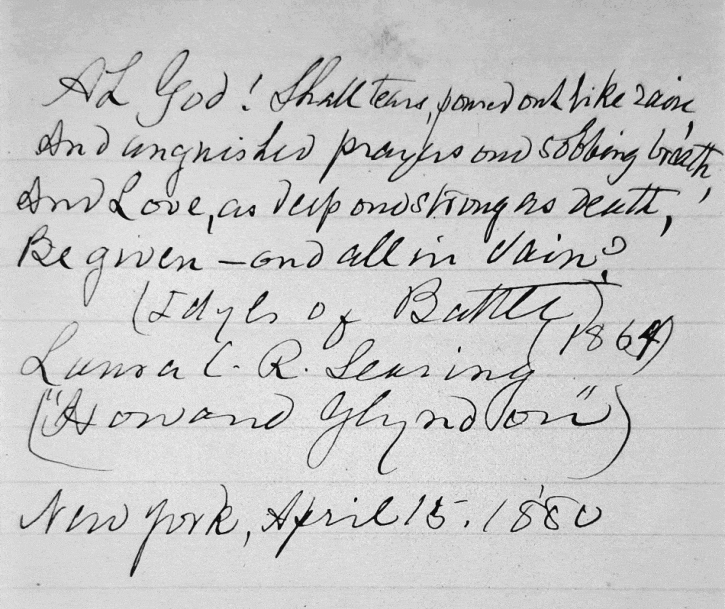
Part of a note written by Laura Searing in 1880 which also shows her Howard Glyndon pseudonym. Image found on Ebay.
As Howard Glyndon, Searing wrote much about Suffragette issues hence she too was a campaigner for womens rights. She in fact wrote a long article explaining why women should have rights and also be allowed to vote. This focus mainly came about after the American civil war had ended. Part of that lengthy passage on the rights of women is shown below:
The present seems a good time to give publicity to the following, as the subject treated of has been again agitated at Buffalo: I have signed the appeal for a sixteenth amendment for the protection of the rights of women citizens of the United States. Not because I have at present any desire to vote, or any private wrongs to right, or any private rights to vindicate by the exercise of the franchise, but because I may sometime wish to vote…
It does not seem to me right, just, or consistent that a large class of people of mature age and fair capabilities, from whom the duties of a full grown human being are demanded and whose responsibilities are, in their way, as great as those of men, to say no more, should in this age of liberal tendencies be catalogued with idiots and minors. If women, when demanding, are denied the right to vote, that clause of the American Declaration of Independence which solemnly proclaims that all men, i.e., all human beings, are born free and equal is a dead letter in the country whose government is built upon this declaration as upon a rock.
If ignorant, brutish, and debased men are thought fit to exercise the high right of voting, why prevent refined, cultivated, and conscientious women from doing so? It is a poor rule that will not work both ways.
Speech didn’t come to Redden until much later. Her instruction in oration was in fact garnered under the tuition of Alexander Graham Bell. Little is known about that however Laura Redden was only able to acquire a limited extent of speech – thus her experience and her subsequent writings from then on stressed that the use of sign language was just as important as the use of speech. In a sense this is was what would be recognised nearly a hundred years later as total communication.
Glyndon is believed to be the only town in the USA ever to be named after a woman writer within her lifetime
City of Glyndon official website.
A nice, recent write up on the Howard Glyndon biography – Sweet Bells Jangled; Laura Redden Searing. A Deaf Poet Restored.
Sweet Bells Jangled is published by Gallaudet University Press. An except of the book featuring Laura’s poems can be found at the university press’ website.