Deaf mothers & domestic abuse
Summary of the Sign LOUD Report: Deaf Mothers, Domestic Abuse, and Communication Challenges
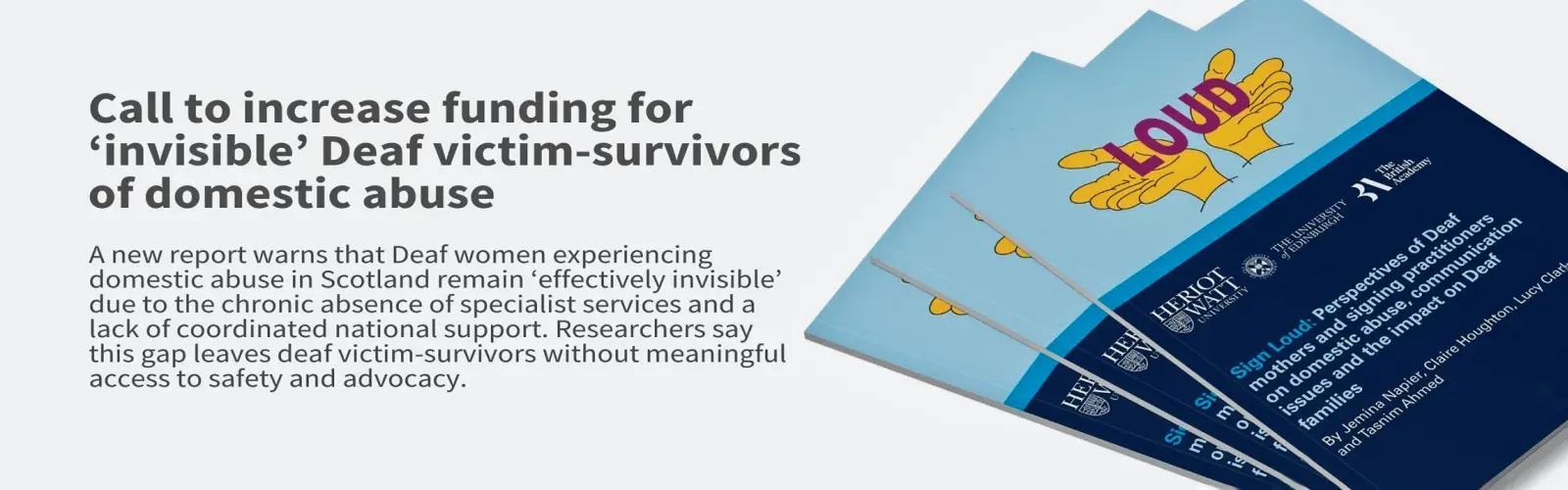
Deaf21 briefly reported on the Sign Loud project in November 2025. The report has been completed and is now published but so far few organisations have made mention of it. The Sign LOUD project investigates the experiences of Deaf mothers who are British Sign Language (BSL) users facing domestic abuse, focusing on communication barriers and impacts on Deaf families and children. What is no doubt a landmark study focusses on the experiences of six Deaf mothers (victim-survivors of domestic abuse) highlighting distinct challenges and proposing actionable recommendations for policy and service improvements in Scotland. Even though the report is specific to Scotland there’s no doubt it can also be used to highlight the situation that Deaf domestic violence survivors too face in England, Wales and Northern Ireland. In other words Mainstream (hearing) services lack cultural and linguistic awareness, leading to miscommunication, exclusion, and negative stereotyping of Deaf mothers as aggressive or incompetent. Not only that Deaf women find it most tiring because there is a continual need to educate professionals.
Lived Experience of Deaf Mothers
The report focuses on the unique situations faced by Deaf mothers. Unique because society is almost entirely hearing and speech based therefore, compared to those who are hearing, Deaf women are more likely to be victims of domestic abuse – with one main reason for this situation being the lack of provision support and also the ways and means the police authorities operate.
- Unique Nature of Domestic Abuse in Deaf Contexts
Deaf women experience domestic abuse differently from hearing women due to visual and linguistic dynamics. Abusers exploit communication modalities (e.g., facial expressions, control of visual environment) and hearing privilege to exert control. This results in a double trauma plus systemic barriers due to audism and lack of Deaf-specific services. - Isolation and Community Dynamics
Profound isolation is worsened by lack of BSL-accessible information and few professionals with Deaf awareness. Although Deaf community networks can offer support, the close-knit nature can also increase risks of confidentiality breaches and further abuse, especially if the abuser is from the Deaf community. - Specialist Deaf Domestic Abuse Support
Deaf mothers and practitioners call for specialist domestic abuse services directly delivered in BSL preferably by Deaf professionals. Such services should include mental health support, advocacy, and targeted assistance for CODAs and Deaf children, with family-focused interventions to promote recovery. - Impact on Children
Children—both Deaf and hearing Children of Deaf Adults (CODAs)—are also victims who are too exposed to verbal, emotional, and physical abuse. Deaf children are highly sensitive to visual abuse cues, while hearing children experience auditory triggers. Mothers worry about the emotional and psychological toll on children. - Access to Information
Deaf women face significant barriers accessing domestic abuse information in BSL, leading to delayed recognition of abuse and support options. There is a persistent ‘Deaf tax‘ which can be construed as the extra effort and costs that are necessary to secure interpreters and accessible communication. - Mother-Child Communication
Shared BSL use fosters emotional closeness and resilience however, Deaf mothers often struggle to communicate about abuse which is necessary to protect the children’s integrity. This leads to delayed or limited disclosure and it can have an effect on the child’s confidence. A lack of Deaf-specific resources also increases the risks further and this can complicate any recovery. An additional problem here is that often children are also expected to interpret for their mothers. - Sign Language Brokering by Children
In the absence of interpreters, Deaf mothers often need to rely on hearing children to act as interpreters because of a shortage of interpreters. This sign language brokering exposes children to trauma, confidentiality breaches, and emotional strain. While some children are no doubt able to help, it is quite a deep responsibility and it can be psychologically damaging. - Interpreter Provision
A lack of qualified BSL interpreters causes delays in police, court, and social work processes, undermining safety and trust. Deaf mothers prefer face-to-face interpreting for sensitive cases, while video remote interpreting may be a short-term emergency solution. Multiple Deaf family members needing interpreters complicates logistics and funding. - Recognition of Mothers’ Roles
Deaf mothers frequently feel invisible to professionals during critical moments involving their children, exacerbated by communication barriers and societal stigma about Deaf parenting competence. They strongly resist using children as interpreters for abuse-related communication but sometimes feel forced to due to lack of alternatives. - Family Dynamics and Intersectionality
Hearing families often lack sign language use, compounding isolation. Language power imbalances allow perpetrators to manipulate relationships and interactions with services. Intersectional factors, such as ethnic minority status and use of other spoken languages, and all of these add complexity.
Conclusions
There is no doubt the Deaf mothers’ experiences of domestic abuse are clearly compounded by communication barriers, audism, and systemic exclusion. Children in Deaf families are co-victims and face unique risks, especially when they are relied upon as interpreters. There is a critical need for culturally competent, trauma-informed, and linguistically accessible services that recognize Deaf mothers’ parenting capabilities and ensure their participation in decision-making. Mainstream (hearing) services lack awareness and there is miscommunication plus negative stereotyping of Deaf mothers. Deaf women are exhausted by the continual need to educate professionals. The Sign LOUD project lays a foundation for policy reform and innovative service provision to ensure Deaf families receive equitable protection, justice, and recovery support.
Sign LOUD Report: Perspectives on domestic abuse, communication issues and the impact on deaf families.
Other information including BSL videos summarising the report can be found at the Sign LOUD site.