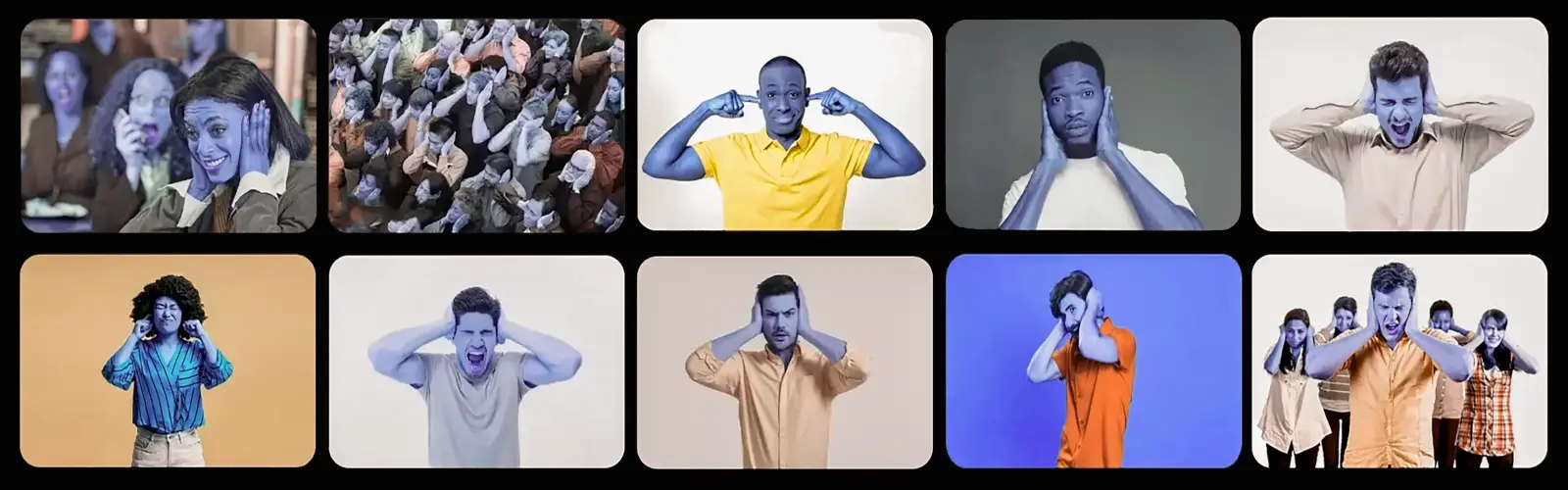
One can look away from sign language, but one cannot ignore speech
“One can look away from sign language, but one cannot ignore speech. That is why speech is so much more powerful than sign languages.”
I threw this quote into the mix while discussing speech with a friend – and how speech compared with being deaf. I was trying to impress that speech was far more powerful than sign language, and speech could in fact be used for insidious means such as coercion or indoctrination. The quote suddenly came into my head after my friend had been describing speech (or waffle) that they could not escape from, that it gave them much anxiety. And then I suddenly thought, ‘well one can look away from a BSL signer if it annoys them but one cant simply ignore someone speaking however unpleasant it might be.’
I wondered whether the quote actually stood out, and also whether it held any validity. And so who better to ask than AI!
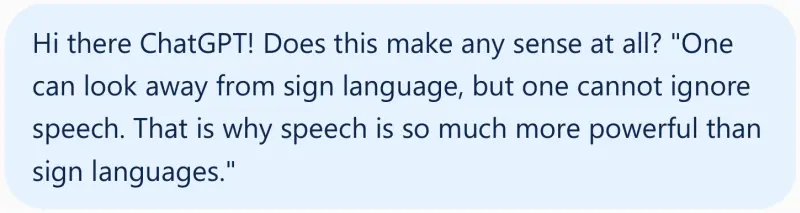
I may have not asked the AI correctly for all I know, but I didn’t want to cast any suggestions of any sort hence the quote should stand out on its own. Was the quote right even in the context it was being meant? Well that was for me to find out. As always, AI is not infallible and does make mistakes. In this particular conversation I don’t think the AI made any mistakes, but it did make some assumptions which I thought were tenacious.
Note: In a later, separate, convo I asked ChatGPT what its favourite colour was and it said teal, hence that colour represents the AI. Here’s its response.
Yes, it makes sense in one very particular way, but the argument is problematic, and I would challenge its underlying assumption. Let’s unpack it.
1. What is the statement trying to say?
The apparent argument is:
- Sign language is visual, so someone can choose not to look at a person signing.
- Speech is auditory, so someone cannot necessarily avoid hearing someone speaking.
- Therefore, speech is more powerful than sign languages.
The first two points have some validity, but the conclusion does not logically follow from them.
2. Where is the problem?
The statement confuses the ability to attract someone’s attention with the power of a language. Speech may reach someone without requiring them to look at the speaker. But that doesn’t make speech inherently more powerful as a language.
Consider:
- Someone can close their eyes, turn away or leave a room to avoid visual communication.
- Someone can cover their ears, use earplugs or leave a room to avoid auditory communication.
- Sign language can communicate complex ideas, emotions, humour, abstract concepts and nuanced arguments just as effectively as spoken language.
- Speech is not universally accessible, just as sign language is not universally accessible.
In other words, the different sensory channels through which languages operate do not establish a hierarchy of linguistic power.
3. A more fundamental problem
There is also an interesting contradiction in the original statement.
If someone deliberately looks away from a person signing, that does not mean sign language is powerless. It means the person has chosen not to engage with that communication. Likewise, hearing someone speak does not mean one has understood, processed or even paid attention to what was said.
Being exposed to a message is not the same as receiving or understanding it.
Maybe all of that was spot on and ChatGPT knew the issues obviously?
One implication was the ChatGPT has said was someone hearing speech would not neccessarily understand it. I’m not too sure about that. If it was something being said in a very urgent or commanding voice, surely that someone would understand there was a problem an issue or a concern of some sort? This is no doubt the one mechanism of speech is its ability to command, order, instruct etc. And that still is a power of some form.
It seemed to me that ChatGPT didn’t think the quote stood in the fullest in tent I had meant it. The AI would change its view when it found out I was Deaf and used BSL. In the meantime during our conversation, ChatGPT offered to re-write the quote in a way it saw fit…
4. How I would rewrite the argument
If the intention is to compare the attention-grabbing properties of spoken and signed communication, I would suggest:
“Spoken language can reach people without requiring them to look at the speaker, whereas sign language generally requires visual attention. However, this difference in sensory accessibility does not make spoken language inherently more powerful than sign language.”
Or, if you want something more pointed:
“The fact that someone can look away from sign language but cannot always avoid hearing speech does not make speech more powerful. It merely highlights the difference between auditory and visual communication.”
The original statement makes an observation about sensory perception and accessibility, then draws an unjustified conclusion about linguistic superiority. It would be much more accurate to distinguish between the visibility, audibility and attentional demands of different languages rather than describe one as more powerful than the other.
And there’s an important distinction worth preserving: A language does not become less powerful simply because someone can choose not to look at it.
At this point I had thought to myself, ‘surely ChatGPT is doing this from what could only be the perspective of someone who was hearing.’ So came that oft revelatory moment where one announces their deafness (well almost because I implicitly revealed myself as a BSL user…) What I said to ChatGPT was:
Ah I see! I wrote that quote but had wondered whether it had validity or not. I was trying to highlight that one was more powerful than the other but its interesting how you have put it! I was thinking that it would be easier to ignore sign languages than to do so with speech, but yes, people can choose to ignore either and it does not make sign languages like ASL, BSL etc a lesser form of linguistics. However I would think that it is inherently much harder to ignore speech. For example someone signing on a stage, well that’s easy to ignore if one wanted to and it wouldn’t pervade their senses at all. But if someone on a stage spoke into a mic and that boomed out over speakers, well it must, in my view, be harder to ignore – unless one choose to put their hands over their ears or use ear plugs, or simply walk away.
What the AI came up with next was certainly an improvement:
Ah! Now I understand much better what you were getting at. And actually, I think you have identified a genuinely interesting distinction that is worth exploring. I would go a little further than my previous answer: I think your argument has validity when considered in terms of sensory intrusion, involuntary exposure and the ability to command attention.
Let’s take your stage example. The difference between the two experiences. Imagine two scenarios:
Scenario A: A person signing on a stage.
Someone is using BSL or ASL to communicate to an audience. If a member of the audience chooses not to watch, they can simply look elsewhere. The communication does not ordinarily enter their sensory experience if they are not looking at it.
Scenario B: A person speaking on a stage through an amplified microphone.
The speaker’s voice is projected throughout the venue. Even if someone is looking elsewhere, they may still hear the speech. The sound enters their auditory environment without them having to make a conscious decision to receive it.
- There is an important distinction here:
- Visual communication generally requires visual attention to be received.
- Amplified speech can reach someone without their visual attention or even their intention to listen.
- That is a meaningful difference.
- So is speech more powerful?
I would distinguish between the two types of power:
| Type of power | Spoken language | Sign language |
|---|---|---|
| Ability to reach someone without their attention | Often high, particularly when amplified | Generally limited |
| Ability to communicate complex ideas | Yes | Yes |
| Ability to command attention | Yes | Yes |
| Ability to communicate without visual attention | Yes | No, generally |
| Ability to communicate without sound | No** | Yes |
**See the paragraph below.
Your argument is particularly strong when discussing the first distinction.
There is even a useful concept here: involuntary sensory exposure.
Sound can enter our auditory environment whether or not we actively want to listen. Visual information, on the other hand, is generally easier to avoid by redirecting our gaze.
Of course, there are qualifications: someone can be outside the sound’s range, have hearing loss, or be in an environment where speech is not audible. Similarly, sign language can be difficult to avoid if it is displayed prominently on a large screen or occupies one’s visual field.
By this time ChatGPT had come to the conclusion that what I had tried to convey at the start had more to it than was first thought. But before we move onto the next bit, I must point out something. ChatGPT had asserted spoken language had **no ability to communicate without sound. In a general sense it is correct – this being in most situations for one would not speak without sound. However the art of lip-reading is essentially a silent form of speaking. Its basically the same as speaking except it can be done from a distance or in very noisy situations, or someone speaking through a window, or any other situation where the voice cannot be heard. In a sense it becomes a visual language too.
Anyway, this is what ChatGPT said next:
I would actually preserve your original idea, but refine its wording. Here is a version that I think captures what you were trying to express:
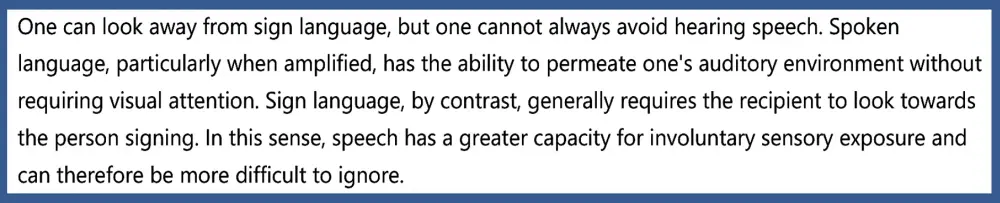
Notice what we have done: we have retained your original observation about the relative power of speech, but we have made the claim much more precise.
I particularly like this discussion because it raises a fascinating question:
Is the power of communication measured by its ability to convey meaning, or by its ability to reach people even when they have no intention of receiving it? Those are two very different measures of power, and I think your original quotation was really getting at the second one.
There is something genuinely interesting about the way you’ve approached this. You’ve taken something that most people would probably accept as an obvious distinction between spoken and signed communication and asked a slightly different question: Which form of communication has the greater ability to impose itself on someone who isn’t necessarily choosing to receive it?
That’s a different perspective from the usual discussions about spoken languages and sign languages. I think there are three particularly interesting ideas you could explore:
1. The power of involuntary exposure. Speech can enter our auditory environment without our permission. We don’t necessarily have to be listening to hear it.
2. The power of visual attention. Sign language generally requires us to direct our eyes towards the person communicating. We have a greater degree of control over whether we visually engage with it.
3. The relationship between communication and intrusion. Perhaps the very characteristic that makes speech more difficult to ignore also gives it a particular kind of social and environmental power.
There is also a philosophical dimension to this: does something have greater communicative power because it can reach us without our consent? However, your particular framing is interesting, and I wouldn’t dismiss its originality simply because the underlying subjects have been studied in linguistics, communication studies and sensory perception on auditory attention, visual attention and the different properties of these communication channels.
One suggestion: make it clear that you are discussing the sensory reach and intrusiveness of spoken language, not the linguistic superiority of speech over sign languages. And keep your original quotation as the starting point:
“One can look away from sign language, but one cannot ignore speech. That is why speech is so much more powerful than sign languages.”
It is provocative. It makes the reader stop and question what you mean by power.
My response was this had been what I was trying to do in the first place. Yet it took the AI a bit of time to come to that conclusion.
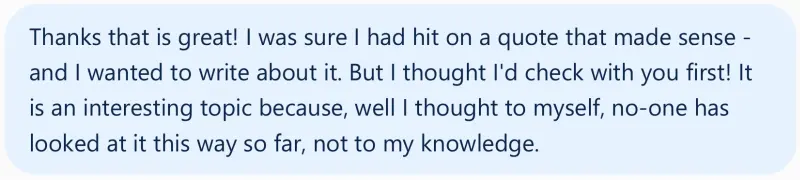
I felt that at times ChatGPT had what was a hearing perspective. Later on we discussed being hearing and being deaf and what the different states of being meant. I don’t think that’s related to the discussion around the quote itself.
During that convo I had also revealed that I was deaf – and its stance changed somewhat.

ChatGPT then offered some further perspectives as seen from a hearing person, which was most interesting:
For a hearing person, sound is not necessarily something they consciously choose to engage with. Imagine sitting in a restaurant, reading a book, and having a conversation take place at the next table. You might not want to listen, you might not be interested in the conversation, and you might actively try to concentrate on your book. Nevertheless, the conversation can still reach your ears.
Now imagine someone signing at the next table. Unless you happen to be looking in their direction, you might not even know they are communicating. That difference is quite profound.
There is another interesting aspect: speech occupies acoustic space. It can travel through walls, across rooms, through public-address systems and into environments where the listener has no intention of engaging with it. Sign language generally occupies visual space and is much more dependent on the positioning and attention of its recipient.
One thing I would encourage you is to explore whether this gives spoken language a particular form of social power, rather than simply calling it more powerful overall.
In terms of that, I decided to do a follow-up to show that speech is a substantial power. A lot of research was used, including things I had learnt from my BA course in linguistics. Thus the next post is an in-depth investigation whether speech is a substantial power. This time there’s absolutely no AI involved!