Ridicule (1996)
Ridicule is a 1996 French film that features the Abbé de l’Épée. The film tells the story of the Abbé de Villecourt, played by Bernard Giraudeau. De Villecourt is an influential figure at the court of Versailles, and one who uses a sharp wit to court favour with the king and his nobility.
The film is directed by Patrice Leconte and part of its setting entails the Palace of Versailles. The movie critiques social injustices and the sheer hypocrisy of the nobility through wordplay and wit. Hence its a comedy in portraying how the nobility lived. The film embodies the hypocrisy and cruelty of this aristocracy, where the power of words can wound as easily and deeply as physical violence. This was a time when wit and the ability to ridicule others were important social weapons for gaining status at court.
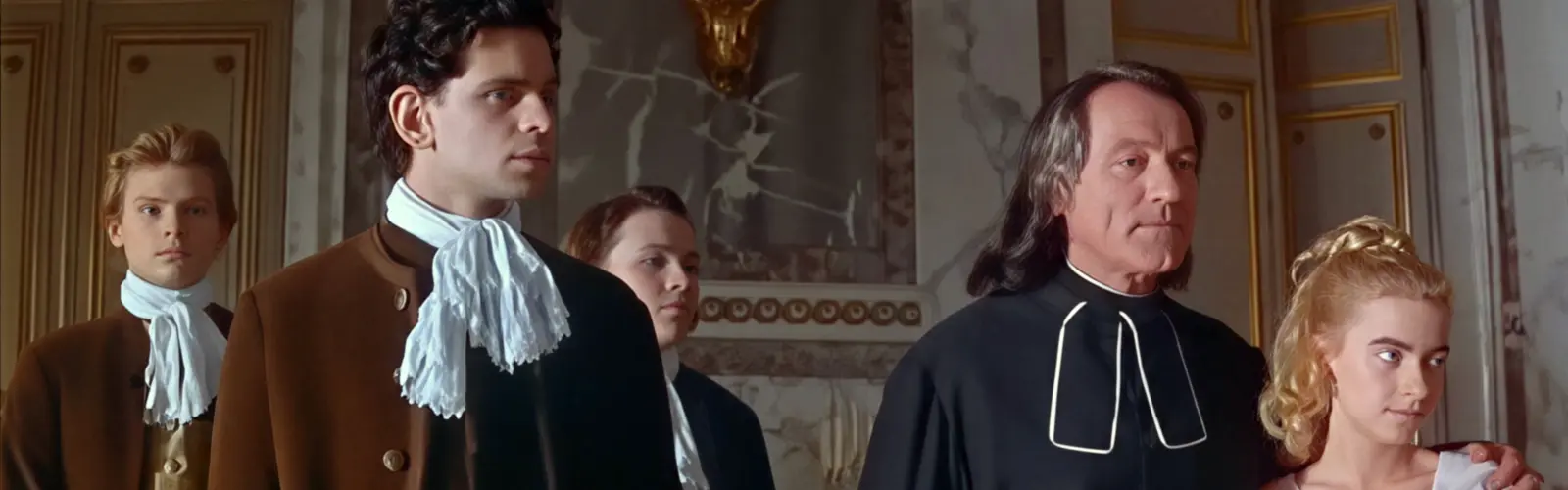
Part of the film features a demonstration by the Abbé de l’Épée of some of the pupils he has taught by sign language. Naturally the palace’s nobility don’t take this endeavour by the Abbé very well and they hurl ridicule after ridicule at the Abbé. In the end the sequence sees the tables turned upon the nobility!
The film is interesting because it historically shows how people (not just the nobility) viewed the Deaf.
The star of the film, Bernard Giraudeau, is well known for narrating the French version audiobooks for the first four Harry Potter books: Philosopher’s Stone, Chamber of Secrets, Prisoner of Azkaban, and Goblet of Fire.
The Abbé de l’Épée is played by Jacques Mathou and well known star of the French screen. His role in Ridicule was a small one thus its not usually listed in Mathou’s Wikipedia entry.
Ridicule (1996) from Youtube.
One can view this segment from Ridicule in English by choosing subtitles and then in settings pick the option where the subtitles can be translated to English. On some browsers it doesn’t work so one needs to go to the film at Youtube to do this. Don’t know why that is!
Below is the full translation of the film’s segment into English (this was done by copying the film’s French transcript, then using Google to translate):
Hubbub…
Abbé de l’Épée:
Why is the deaf-mute an isolated being in nature? Incapable of communicating with other people, doesn’t he, like us, receive impressions from objects? Why does he remain stupid… and why do we become intelligent?Noble Idiot: Because it is written, In the beginning was the Word!
Laughter…Abbé de l’Épée:
Plato has Socrates say, ‘If we had no voice and wanted to show things to one another, wouldn’t we try, like mutes, to indicate them with our hands, our head, and the rest of our body?’ Here is Simon, son of a merchant, 25 years old, deaf and mute from birth. He arrived at our institute at the age of 15. Thanks to sign language, he can now read, write, and count… He has the soul of an artist. Here are Antoine, Pierre, and Thérèse… 19 years old, she’s been with us for three years. She can do four-figure math in her head. She’s very devout.Sarcastic laughter…
And here’s Paul, 17 years old, an exceptional student. He learned my sign language in less than two months. He can already hold a conversation. Next spring, I will have the joy of uniting Thérèse and Paul before God.
Audience: Ohhhhhhh!!!
Man: How dare you flout the sacraments of marriage with these wretched creatures?
Courtesan: I once saw Romeo and Juliet performed in Paris… with a monkey and a poodle.Laughter…
Man: Can the groom even tell the time on this clock?
It’s three minutes fast, sir.
Girl: Well done, Paul!
Courtesan: Speak up, miss, he didn’t hear you!Laughter…
Courtier: Ask my father what a violin is for.
Abbé de l’Épée: The painter Watteau took more pleasure in seeing a violin than in hearing it.
Courtier: But tell me, Father… do they suffer from their disgrace?Amused laughter from the audience…
Courtier: What did he reply?
Abbé de l’Épée: Sir, that’s impossible to translate into our language; it’s a witty remark…Le Marquis de Bellegarde: How do you say ‘Bravo, sir’ in your language?
Courtier: Like this!Loud applause from everyone!