The Abbé de L’Épée
The Abbé de L’Épée is a revered figure in the history of the deaf. Presented here is a text from a popular French magazine published 100 years ago. The translation is straight off Google – so it may not be completely spot on. The article is of interest because it describes the life of the Abbé de L’Épée in more or less a summary – and it can be a useful introduction for anyone researching/reading up on the history of the deaf and sign language in terms of the impact the Abbé had upon the deaf world. The text is from the French magazine Dimanche Illustre for 1st May 1927.
Charles-Michel de l’Épée was an 18th-century French Catholic priest and philanthropic educator who advocated for sign language as the preferred method of teaching deaf people, and has become known as the “Father of the Deaf”. Wikipedia
The the Abbé de L’Épée was born on 24 November 1712, Versailles, France. He died on 23 December 1789 at the age of 77 years. The education the Abbé received was at the University of Paris and Collège des Quatre-Nations.
In the previous post we had a look at the film Ridicule. This seems to mimic a situation based upon that mentioned in the passage below where the King attended a demonstration of the Abbe’s students demonstrating their knowledge and acquisition of language through sign. The real event was perhaps a more serious affair because the film was intended as a satire.
The novel of life: Abbé de L’Épée – He made the Mute speak and the Deaf hear – by Jean-Bernard.
Abbé de L’Épée was one of humanity’s greatest benefactors. It is his remarkable apostolate, his life of tremendous labour, human charity, and sublime devotion, that our contributor Jean-Bernard recounts in this article.
If you visit the Institute for the Deaf and Mute, you will see, in the middle of the entrance courtyard, a beautiful statue of Abbé de L’Épée, unveiled in 1879, depicting the educator of the deaf and mute with one of his young pupils. Three base reliefs decorate the pedestal.
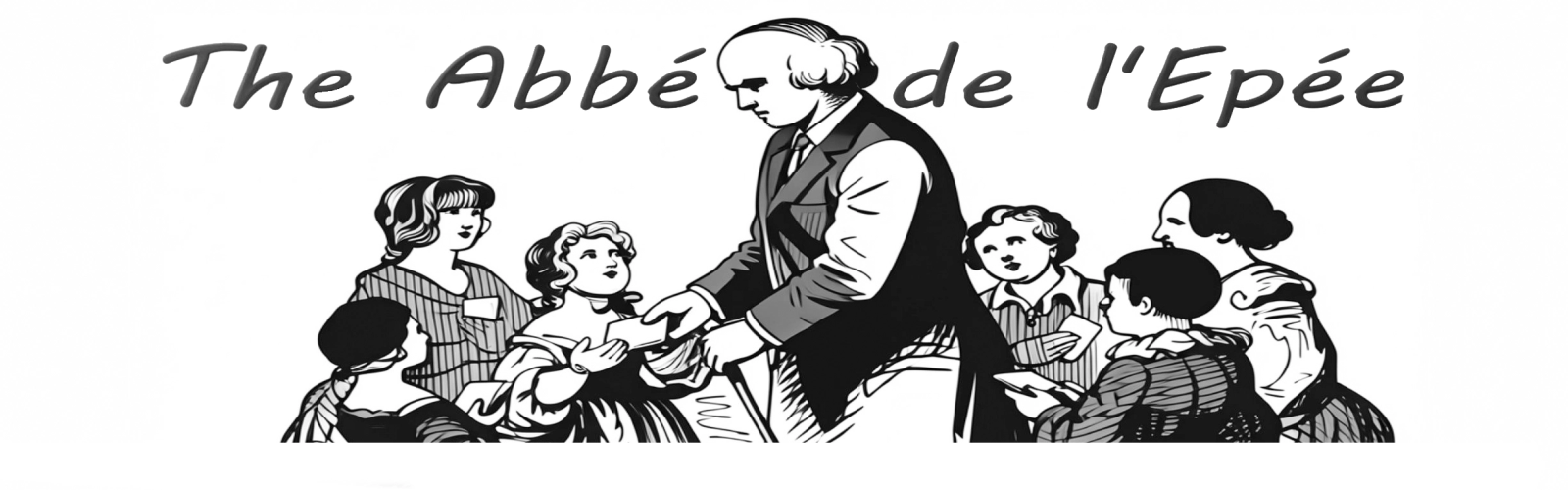
The first shows the Abbé surrounded by a group of deaf and mute children accompanied by their mothers. The second depicts Joseph II, Emperor of Austria, brother of Queen Marie Antoinette, visiting the institution and proposing to Abbé de L’Épée that he establish his school in Vienna. The third, finally, depicts an anecdotal scene from the professor’s life when, during the terrible winter of 1788, he refused to have a fire lit for him in order to preserve all his resources for his children.
These three base reliefs summarize the life of this great benefactor of humanity, who honored 18th-century France. When Abbé de L’Épée embarked on his mission, attempts had already been made in various quarters and none had succeeded.

The statue of Abbé de L’Épée at Institut de Jeune Sourds (Institute for Young Deaf People) in Paris. Wikipedia.
Until the 6th century, deaf-mutes were considered a kind of monster, subjected to the worst treatment. They were even put to death like malevolent beasts. It was in the second half of the 16th century that a Spanish Benedictine broke with this barbaric prejudice and tried to provide these unfortunate disabled people with a basic education.
This Benedictine, Pierre de Ponce, conceived the idea of teaching these unfortunate souls to write. France only took an interest in deaf-mutes much later, and it was also a religious, Father Varrin, of the Christian Doctrine of Saint-Jean des Ménétriers, who, in the second half of the 18th century, attempted to compensate for the lack of speech by showing engravings to deaf-mute children. The results were practically nonexistent. It was by chance that Abbé de L’Épée met two young girls, two sisters, students of Father Varrin, who had just died. He took up the work of this religious and tried to prepare these two children for their First Communion.
This priest, who devoted himself to this thankless mission, was born in Versailles in November 1712. His father, who possessed a considerable fortune, was the king’s architect. After excellent classical studies, the young man entered the seminary of Saint-Sulpice; but, at the moment of receiving minor orders, the tonsure, he hesitated because of the papal bull Unigenitus, which he did not approve of. He then studied law and was admitted to the bar of the Parliament of Paris. Reconnected by his religious vocation, he was introduced to Bishop Bossuet of Troyes, nephew of the great Catholic orator, who ordained him a priest and granted him a canonry. At the urging of his family, Abbé de L’Épée came to Paris, where he joined the Jansenists of Port-Royal. The Archbishop of Paris suspended him, and for a time, the young priest fell out of favor.
It was then that he met the two deaf-mute girls, students of Abbé Varrin, and decided to dedicate himself to the education of children afflicted with this terrible disability. To avoid hindering his new ministry, he retracted his Jansenist ideas and thus returned to the regular clergy more out of professional necessity than conviction. It is known that Pope Pius V had condemned, in seventy-nine propositions, the Jansenist theories drawn from Saint Augustine, which gave considerable weight to fatalism, suppressing free will and consequently depriving humankind of the merit of good and the responsibility for evil.
Abbé de L’Epée had to disapprove of this doctrine, which, however, was dear to him, and, abandoning all theological controversies, he thought only of charity and began to seek out deaf-mute children, especially the poorest. His father was wealthy; He inherited an income of 12,000 livres — which, at the time, was something — and a fairly large house on rue “Butte-aux-Moulins”, which was “then located near the church of Saint-Roch.
It was in this house that he opened his classroom, and it was with his own resources that he undertook this free teaching. He began in 1771 with about twenty students. Ten years later, he had one hundred. His method developed almost day by day. After starting with lip-reading, making words understood through lip movements, he continued with sign language formed with the fingers. The results were very satisfactory.
It was during this ministry that Abbé de L’Épée asked himself a question that had not yet been addressed: whether deaf-mutes had memory.
To this end, he took his children to the Palace of Versailles, where he showed them its beauty, and upon their return to Paris, he asked them, using signs, what they had seen. The question was settled: deaf-mutes remembered everything, just like other people. This contradicted the theories of several philosophers who, without experience, adopted the thought of Saint Augustine, who wrote: “The deaf and mute cannot remember.”
This established point was not only a convincing answer to the philosophers, but it also became of great practical importance. Having the ability to remember, the deaf (the original says ‘these unfortunate people’) could retain and repeat the gestures they were taught and they become laborers, masons, carpenters, painters, bookbinders, thus earning their own living instead of remaining a burden on their families – or condemned to poverty for their entire lives.
By 1780, Abbé de L’Épée’s success was complete and undisputed. Students came to him from various places to create similar schools in the provinces. The Archbishop of Bordeaux sent him Abbés Sicard and Saint-Semin, who learned the methods and even perfected them. Foreign priests went to his institute and, after a more or less lengthy period of study, returned to establish similar schools of their own. There were some in Spain, Switzerland, Holland, and Austria.
When Joseph II, Emperor of Austria, brother of Marie Antoinette, visited France as an incognito – that is, without receiving honors, on May 7th he wished to attend a class taught by Abbé de L’Épée. “I am eager,” he said, “to meet this benefactor of humanity.” For two hours, he asked all sorts of questions and questioned the children who understood lip movements and responded with the sign language alphabet.
Before leaving the house on the Butte-aux-Moulins-Saint-Roch, the Emperor offered the Abbé a substantial sum of money and numerous honors if he would settle in Vienna and establish a large school for the deaf and mute. Abbé de L’Épée was deeply moved, but he refused, not wanting to leave his children, of whom he was, in essence, the sole provider. It was only agreed that Joseph II would send a teacher whom the Abbé would train so that he could open a school in Vienna upon his return to Austria.
Having returned to Versailles after his visit to Abbé de L’Épée, where Louis XVI and Marie Antoinette were waiting for dinner, the Prince said to them upon arriving: “I have just seen a saint who performs true miracles.”
Upon his return to the capital, the Emperor immediately sent to Paris, as agreed, a clergyman, Abbé Starch, who presented himself to Abbé de L’Épée with an autograph letter from Joseph II. Once sufficiently briefed, the priest returned to Vienna where he, in turn, trained students. Thus, Abbé de L’Épée’s method was applied in Germany, Denmark, Holland, Sweden, and Russia. Around the same time, it was also applied in the United States.
Catherine II the Great sent an emissary from Saint Petersburg to persuade Abbé de L’Épée to travel to Russia and establish an institution on the banks of the Neva River similar to the one in Paris.
However, the Abbé could not bring himself to undertake this long journey and refused. Meanwhile, expenses increased daily due to the growing number of students, while resources dwindled. Despite the Treasury’s shortages, King Louis XVI was forced to take over the care of the deaf-mute school, at least in part, and in 1785, he covered a small portion of the expenses by contributing 6,000 francs annually. This was a quarter of what was strictly necessary.
At the same time, the former Celestines convent was made available to the Abbé, where classes for boys and girls were established.
The terrible winter of 1788, which saw the Seine freeze to such an extent that even the heaviest carriages could cross it, imposed further hardships on the entire poor population.
Abbé de L’Epée, reserving all the wood he could find for his children, endured the most intense cold.
At night, he walked around his room to avoid freezing in his small, fireless apartment. By 1789, the abbé had spent his entire fortune and was on the verge of running out of resources. His only means of subsistence was the meager stipend from the Mass he said every morning at the Church of Saint-Roch, a stipend that did not exceed six or seven sols.
At the beginning of December 1789, exhausted by his enormous workload and by old age, the abbé took to his bed and died on December 23rd. He was seventy-seven years old. The day before, a delegation from the National Assembly, headed by the Archbishop of Bordeaux, Mgr. Champion de Cicé, who a few years earlier had sent him Abbé Sicard, came to see him. The archbishop said to the dying man: “You can go to heaven in complete safety; the Fatherland adopts your children.”
A radiance of joy lit the emaciated face of the dying man, and he soon breathed his last. Abbé Sicard was to succeed him.
As for Abbé de L’Epée, he was buried in a family vault in a chapel of the Church of Saint-Roch. It was Abbé Fauchet, a renowned preacher, the very same one who was to play an important role in the Revolution, who delivered his funeral oration.
In July 1791, the National Assembly decreed that the Abbé de L’Epée had rendered great service to the Fatherland.
Link to the article at Gallica.
One might find of interest also Project Gutenberg’s L’Abbé de l’Épée, by Ferdinand Berthier.
Also of interest: The Abbé de L’Épée by Luzerne Ray – American Annals of the Deaf and Dumb Vol. 1, No. 2 (JAN 1848).