Hermeneutical injustice in a hearing world
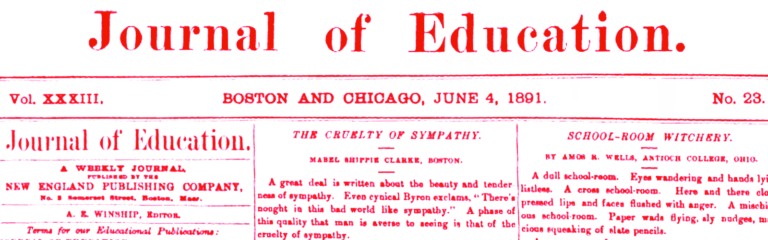
In hearing culture, spoken language is rarely treated as a mere tool for exchanging information. Speech is framed as a force of nature—a ‘war cry’ capable of rallying crowds, interrupting seminars, family (or other social) gatherings and demanding immediate attention. ‘Speech is power; speech is to persuade, to convert, to compel.’ 1 This reveals a fundamental truth about how human society distributes power through its chosen mediums of communication. Another form of that power is its use as a medium against the deaf. The oral versus sign language. This is the phonocentric world the deaf have to face, and adversaries come in the form of oralism 2 and audism. 3
This post is a follow-up to One can look away from sign language, but one cannot ignore speech. It covers the topic of what is known as Hermeneutical Injustice – and wholly important because it describes a number of the situations the deaf face. These are largely because speech is powerful and everyone subscribes to the same modus – such as on social media or even in political discourse – where ideas and notions in fact demean the notion of deafhood and deaf culture, but because the progenitors are hearing, they basically do not care. They may have possibly been informed, but ultimately it makes no difference because its a hearing world – and this is what’s known as hermeneutical injustice. (Note: Epistemic injustice 4 is the broad category, whilst hermeneutical injustice and testimonial injustice are two of its sub categories. Evidently in terms of the deaf being ‘silenced’ by the hearing world, hermeneutical injustice has to be the category that is used).
Essentially, there is an overabundance of oppressive concepts which collaborate to exclude out, defeat, or pre-empt any means of gaining a wider and more greatly understood perspective upon the injustice a marginalised group experiences. For example this can be the hearing society which choses to ignore the experiences of the deaf. When one tries to make a social experience understood, it can’t be done because the hermeneutical tools that are necessary for this are ignored or even blocked – thus social experiences are rendered ineffective to the attention of the majority society. Here’s an example that entails disaibility and hermenutical injustice:
Barnes’ Chapter 6 is a rare philosophical treatment of disability pride. Drawing on Fricker’s conception of ‘hermeneutical justice,’ Barnes argues that disability pride creates epistemic space for disabled people to turn ‘common sense’ bad-difference understandings of disability on their head so that they can begin to make sense of their own experiences and see disability as a neutral or positive trait. In fact, Barnes contends, disability pride makes epistemic room to celebrate disability as a contributing factor to human flourishing against the backdrop of deep-rooted, culturally pervasive assumptions that disability is a bad difference that someone can, at best, thrive ‘in spite of.’ 5
What it means is the deaf suffer from a double burden in trying to make their experiences understood. Any number of deaf persons suffers from what is a harmful experience, and is then further disadvantaged when they are unable to clearly name or communicate the situation to others – eg hearing people. Marginalised groups have less influence on how public language and cultural meanings are shaped, leaving their realities obscured. Very interestingly, hermeneutical injustice covers a lot of ground in terms of marginalised groups, but it seems the deaf are pretty well left out. So that’s likely to be a triple burden because the deaf do not have a voice like practically every other group – and that in turn causes the hearing world to think that the deaf have no need for opinion. Its why the hearing world often goes ahead with ideas that positively exclude the deaf, including terminology, technology, communications, cultural issues and descriptive means (including the use of offensive stuff because they think its okay) on social media, in parliament and across the public sphere.
The Where is the Interpreter? 6 is one example of such means of exclusion by a wholly hearing based system.
Such intricacies in terms of hermeneutical injustice (as well as epistemic injustice) continues because there is a new campaign called Where Is the Interpreter Post-Dispatch? 7 It arose because there is a critical gap in accessibility in terms of the emergency services. Part of that campaign also seeks an increase in BSL interpreter provision. This sort of thing results from a hearing society not knowing or even being aware, or even potentially ignoring, the fact that there’s many who cannot access the resources or means hearing people have.
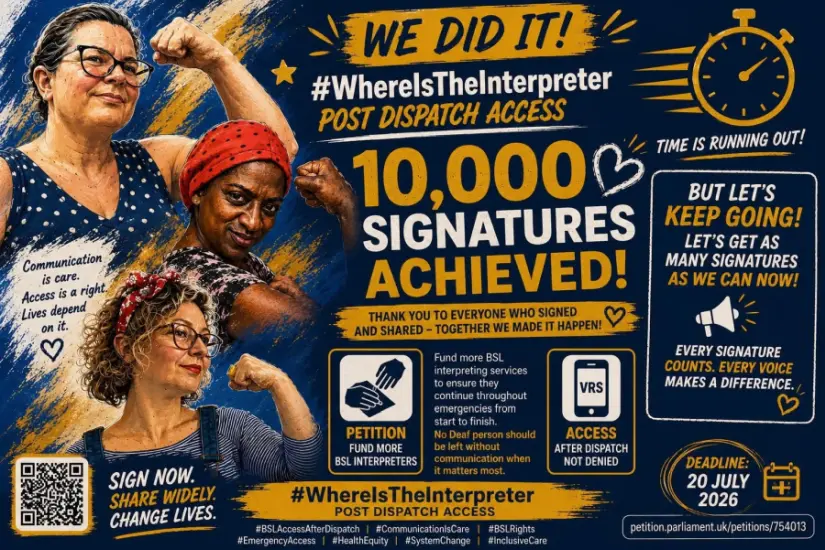
Where Is the Interpreter Post-Dispatch? Facebook.
Hermeneutical Injustice is also about realities. If one has not got the words or the descriptions to use, then their reality is compromised. An extreme example of this is the animal kingdom. It can’t even describe the horrors it faces so the human world assumes pretty arrogantly it has every right to practice numerous insidious things against animals. In a nutshell that clearly means language is necessary in order to find fields of potential equality – or even one of acquiring a lesser harm. This quote by Wittgenstein puts it quite succinctly:
‘The limits of my language mean the limits of my world.‘ Wittgenstein was speaking about the boundaries of thought itself, but his words carry a particular weight for anyone who has suffered invisibly. When we lack the words for an experience, we struggle to grasp it ourselves, let alone explain it to others. And still, the pain is no less real for being unnamed. 8
To start things off properly however, it should be mentioned that speech as a ‘force’ can be quite easily derived from the notion that it was ‘built’ for certain things such as war 9 and hunting animals. As has been illustrated several times on Deaf21, one line of thought upon the origin of speech essentially revolves around humanity’s massive conquest of the animal kingdom. 10, 11 In other words, a sustained war against what are deemed non sentient beings where the hunting and capturing of animals for food and clothing has featured. This has gone on for millennia and today the power of ‘speech’ happens to be enormous because it ‘justifies’ sustained mass killing by way of various explanations, including numerous piss-poor excuses, which quite conveniently ensures the horrific means of meat production is deemed to be ‘humane,’ ‘ethical’ and therefore fully condoned.
One must consider that, especially as a deaf person, that most with speech/hearing will refute, disagree, and oppose any such notion that speech equates conquest of the animal world. That again is another ‘skill’ that speech has and this very ability has been used oft times to refute the deaf, to deny that what the deaf may claim about something (like child sex abuse or other forms of discrimination), in short, to weaken the deaf world’s already fragile assertions even further. In short, to pull the rug out from underneath the deaf world.
The idea here is that language was created to help humans survive. Why? Humans needed to communicate with each other in order to hunt, farm and defend themselves successfully from the surrounding harsh environment. Being able to communicate using language gave the human species a distinct survival advantage. 12
What it means is most deaf, when placed against such hearing adversity, will almost certainly be refuted. Because everyone outside the deaf world speaks, the tendency therein is to believe the hearing speaker. It is why, for example in oralism, many of its advocates as well as others not so strongly associated with such oral chicanery (and it occurred long before those times too), there was strong opinion that the deaf were no better than animals. Thus speech equates power and integrity, whereas being deaf, and using sign language or being mute signifies none whatsoever. Its a rubicon that’s nearly impossible for the the deaf world to cross. And it is also one the animal world sadly will never cross:
“Language is the Rubicon which divides man from beast, and no animal will ever cross it … The science of language will yet enable us… to draw a hard and fast line between man and brute.” 13
Putting the above aside, it must be said speech too has a downside, which I extolled in an earlier post that examined a quote Deaf21 had made – One can look away from sign language, but one cannot ignore speech – which means that speech is an intrusive ‘push hard’ medium travelling through air space without any sort of permission. This pervasiveness ‘allows’ hearing people to effortlessly absorb vast amounts of cultural and social awareness by simply being extant within an audible environment. In other words, its like a fish easily taking to air. Comparably, we the deaf are like fish out of water and we suffer for it. What it means is visual communication (such as BSL, ASL etc) are a ‘pull’ medium which relies on convenient and both a direct line-of-sight and a focussed, deliberate, attention.
On either side of that rubicon British Sign Language (BSL) and spoken English are similar in terms of linguistic depth and expressive beauty. However they do NOT operate on a level playing field in the physical world, and this is why the rubicon exists. Consequently, deaf people are locked out of the passive, everyday flow of information, leaving the community at a distinct structural disadvantage when it comes to building shared awareness – and any chance at projecting a powerful collective message is largely lost.

Such instances denote this is what’s known as a hermeneutical injustice. Its a term that’s received scant attention in terms of BSL (or ASL) and many other sign language studies, yet it carries huge importance as we shall see later. Hermeneutical Injustice, coined by philosopher Miranda Fricker 14 in 2007, is not just applicable to the situation of the deaf, for it fits perfectly the scenarios the deaf have to face in a hearing world.
To reiterate, Hermeneutical Injustice occurs when a group is excluded from the spaces where society creates meaning, language and understanding. Because the deaf are left out of these everyday interactions, they are completely robbed of the shared concepts that are needed to make sense of, or even to explain, their own social experiences within the wider world. In terms of hermeneutical injustice, it is the hearing world which holds the trump cards.
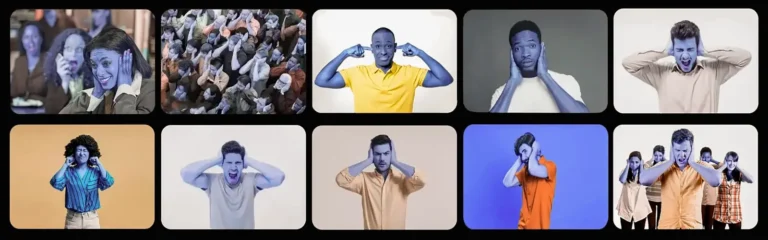
Aside from this injustice, in order to understand why speech holds such immense authority, one must look at how sound and sight interact with human attention. Sound is omnidirectional and also intrusive; it travels around corners, penetrates walls, and enters the human ear without requiring the listener’s consent. Because hearing people cannot simply shut their ears, it means a loud voice, a sudden shout, or an announcement acts as a force that hijacks a hearing person’s focus and demands a reaction.
In the opposite parameter, sign language does not have an impact therefore the hearing world basically ignores the deaf. The following presentation (on Youtube) is of interest:
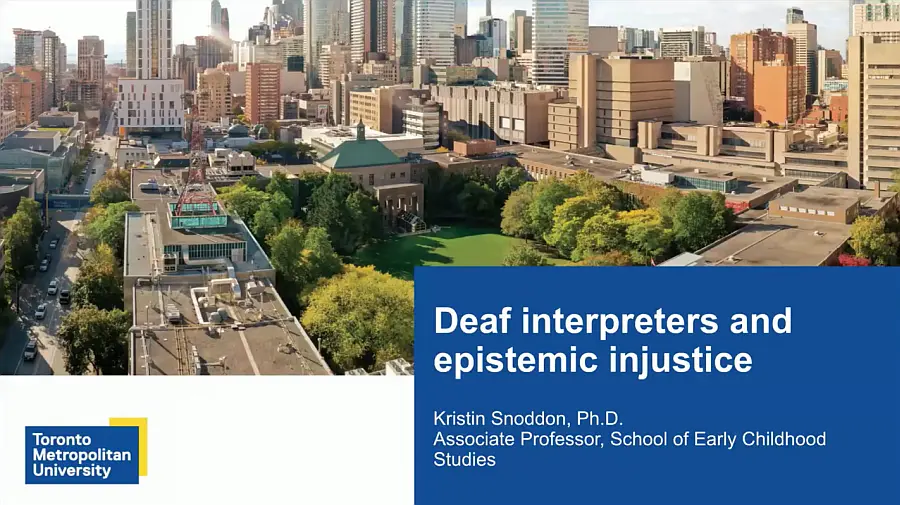
Deaf interpreters and epistemic injustice. A presentation by Kristin Snoddon of Toronto Metropolitan University. Epistemic injustice is the main category that covers hermeneutical injustice – and that is because there’s unfamiliarity with what are deaf social experiences. That distorts any understanding of communication related to the deaf world and any meaning those experiences have in terms of a hearing perspective.
One visual aspect of communication (or sound) closure is the almost total occurrences these days where we can see hearing people with earbuds, headphones, whatever, in an attempt to drown out unwanted, intrusive sounds. Police cars, ambulances, police helicopters, drones, London’s tube system and other things are increasingly noisy in a modern world which seems only too determined to have even more intrusive sounds. And yet no-one hears sign language for it is not intrusive even, thus attention and awareness is hugely lacking.
Thus visual communication operates under what are strict spatial limits. A signed message or a written placard requires direct line-of-sight, adequate lighting, and an audience willing to look in the right direction at the exact right moment. If one turns their head or closes their eyes, the message vanishes instantly. Evidently this is not a question of ‘does the moon still exist when one is not looking at it?’ What it means is spoken advocacy can easily force itself into the public sphere, whereas sign language must wait to be noticed. The ultimatum of this negativity is it renders deaf-led awareness campaigns as being inherently quieter and more passive. Thus its so easy for the wide hearing world to ignore.
Beyond such immediate attention, speech’s acoustic reach creates what might be called an ‘overhearing effect.’ This is a constant and effortless stream of incidental learning that shapes how hearing people understand the world about them. From childhood through adulthood, hearing individuals absorb vast amounts of social, political, and cultural awareness simply by existing in an audible environment. Overheard conversations on a commuter train, background news bulletins on a kitchen radio, or heated debates around a family dinner table continuously update a hearing person’s understanding of current events and social norms without them ever having to ask a question.
Deaf people are instead locked out of this ambient soundscape. Because sign language is limited in its delivery, information does not easily reach a deaf person’s awareness. Every piece of knowledge must be deliberately sought, read, or translated. Like so many other deaf, our experience of family gatherings for example, ensure that we, the deaf, are substantially excluded, without a clue of what is happening or what is being said. Its most excruciating to have to sit in such gatherings and be totally oblivious to what’s going on.
This kind of systemic exclusion can once again be very clearly be seen as hermeneutical injustice. The deaf are placed at an unfair disadvantage in accessing collective knowledge and articulating their own experiences to the wider world. And if they try to raise awareness of such plight, they are easily and conveniently ignored. Ultimately, this structural exclusion from background chatter leaves the deaf community miles behind in shared social awareness, forcing individuals to expend constant energy simply to gain information that hearing people absorb by accident.
This physical asymmetry is further magnified by the fact that human society has built its major institutions almost entirely around the spoken voice. From parliaments and courtrooms to emergency broadcasts and mainstream media, public infrastructure is designed to amplify sound, equating vocal impact and tonal emphasis with authority, leadership, and legitimacy.
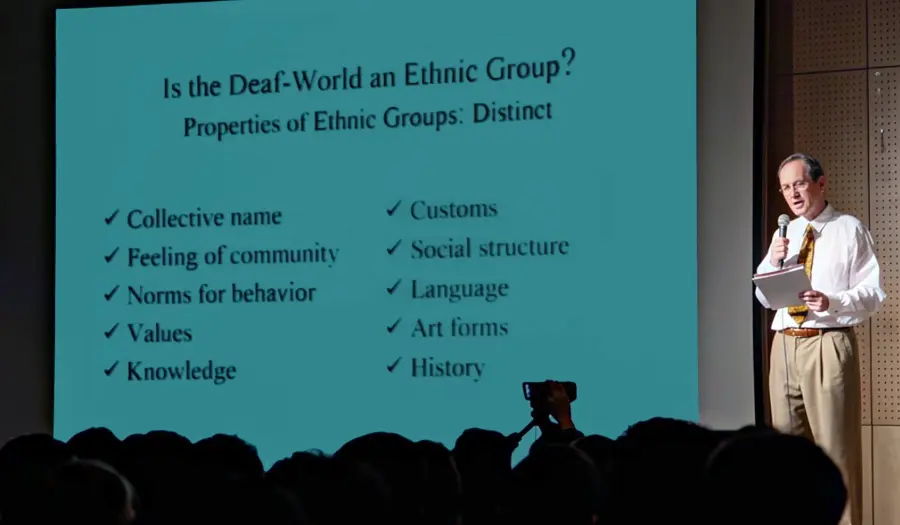
Paris conference (2003) where Harlan Lane is seen presenting his views on the deaf as an ethnic group. Picture taken by Deaf21.
Even everyday English idioms such as ‘having a voice,’ ‘speaking up,’ or ‘making oneself heard’ merely reinforces the idea that power belongs to those who can project sound. That is, the hearing, speaking world. When deaf people attempt to challenge this exclusion or raise public awareness, their messages rarely travel directly into the consciousness of the hearing world. Rather it very conveniently gets excluded. Indeed, many hearing people know they have the upper hand – and a lot exploit that advantage. If it was racism it would be solidly, even violently challenged – but because its audism, its clearly a permissive discrimination.
A good few years ago the deaf were warned not to use the ethnicity card even though leading advocates such as Harlan Lane had advocated such means of use. 15 What it means is its a bit like Ukraine who were told not to have nukes – then they got invaded by Russia. By getting us, the deaf, to adopt fewer defence mechanisms, it has been a convienent method of ensuring further inequality – and the deaf world seems unable to challenge this – because it does not have a voice. The result of that is akin to the ‘Mask of Benevolence’ 16 Harlan Lane had warned of.
Ultimately ideas conceived in the three-dimensional space of BSL must pass through a translation bottleneck, like being converted into written English or filtered through a hearing interpreter – before the wider public will engage with them. This extra layer of mediation inevitably delays the message, and it also strips away any emotional immediacy of the original signing. This places deaf advocacy at the mercy of hearing gatekeepers thus ensuring that even urgent deaf perspectives arrive diluted and second-hand. I have often thought that BSL interpreters were a firewall between the deaf and the hearing worlds. Not only that, we cannot even tell if what the interpreter is signing to us is the fullest information – or it if is being filtered in line with the hearing perspective.
Clearly any imbalance between speech and sign language has nothing to do with linguistic depth. Rahter it has everything to do with the physics of human attention and the structures built around it. Being deaf in a hearing world is a perpetual paradox. The sensory autonomy that shields deaf people from the relentless noise of daily life simultaneously locks them out of the ambient push communication through which hearing society shares power, news, and cultural awareness.
As long as public institutions remain firmly phonocentric – the art of forcing visual messages such as BSL, ASL etc, through a translation bottleneck simply means that deaf communities will continue their uphill battle for whatever social awareness and equality can be sought. True communicative equality will only be achieved when society stops measuring the power of a message by the sound it makes, and begins valuing visual language as an equal force in shaping public consciousness.
This post is part two of a series based on the theme ‘One can look away from sign language, but one cannot ignore speech‘
- Goodreads: Ralph Waldo Emerson quote ↩︎
- Wikipedia: Oralism ↩︎
- Wikipedia: Audism ↩︎
- Wikipedia: Epistemic Injustice ↩︎
- Notre Dame Philosophical Reviews: The Minority Body – A Theory of Disability ↩︎
- Centre for the Deaf and Hard of Hearing: Where Is the Interpreter campaign ↩︎
- Limping Chicken: Where Is the Interpreter Post-Dispatch? Highlights gaps in emergency support for deaf people ↩︎
- King’s College London: Hermeneutical injustice and invisible wounds ↩︎
- International Law Blog: War Cry – speech as participation in hostilities. ↩︎
- Science – How Stuff Works: How did Language evolve? ↩︎
- ResearchGate: Pre-Hunt Communication Provides Context for the Evolution of Early Human Language. ↩︎
- Ditto. ↩︎
- Humanities: How speech began. ↩︎
- Miranda Fricker’s website. ↩︎
- BU Today – Should the Deaf be considered an ethnic group? ↩︎
- Good Reads: The Mask of Benevolence – Disabling the Deaf Community. ↩︎