The men who wouldn’t listen…
By a strange quirk of fate, a certain day in 1876 happened to be the same day two important historical figures made the grade. Both were men who didn’t listen in terms of the fullness of the objectives they were pursuing. As one man demonstrated his new communication device, the other died on a hill. These men were Alexander Graham Bell and General George Custer.
Very ironically it was a deaf person who encouraged Bell to go to the Centennial Exhibition in Philadelphia. This was his soon to be wife, Mabel Hubbard. Bell had thought her cousin, Willy Hubbard, would do for the expected, and first ever public demonstration, on 25th June 1876 which was to be held before the Centennial Awards Committee in the venue’s Machinery Hall. Mabel Hubbard refused the idea and insisted Bell should go. She had to use quite a bit of persuasion it seems. If it hadn’t been for her, Alexander Graham Bell would have not been present at a major demonstration of his new telephone device on a day that shook America.
Bell, like Custer, was another guy who wouldn’t listen. It was a case of “no, things must be done our way.” For Bell it was that the Deaf simply had to follow the hearing doctrine – that is to speak and forsake the need for sign language. And for Custer it was that the American Indian simply had to follow the white man’s doctrine – that is to speak English and forsake the need for sign language. Both men were clearly focussed on an insidious form of assimilation that involved both the affected groups having to learn a new oral language and in the process, forsake their sign languages.
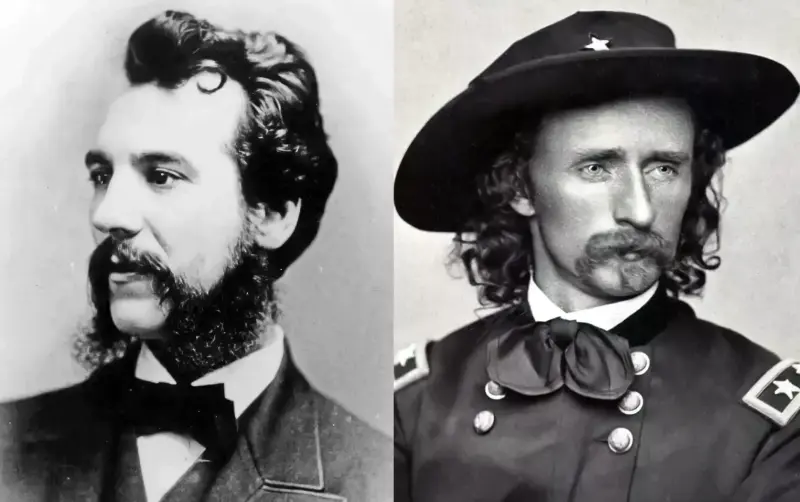
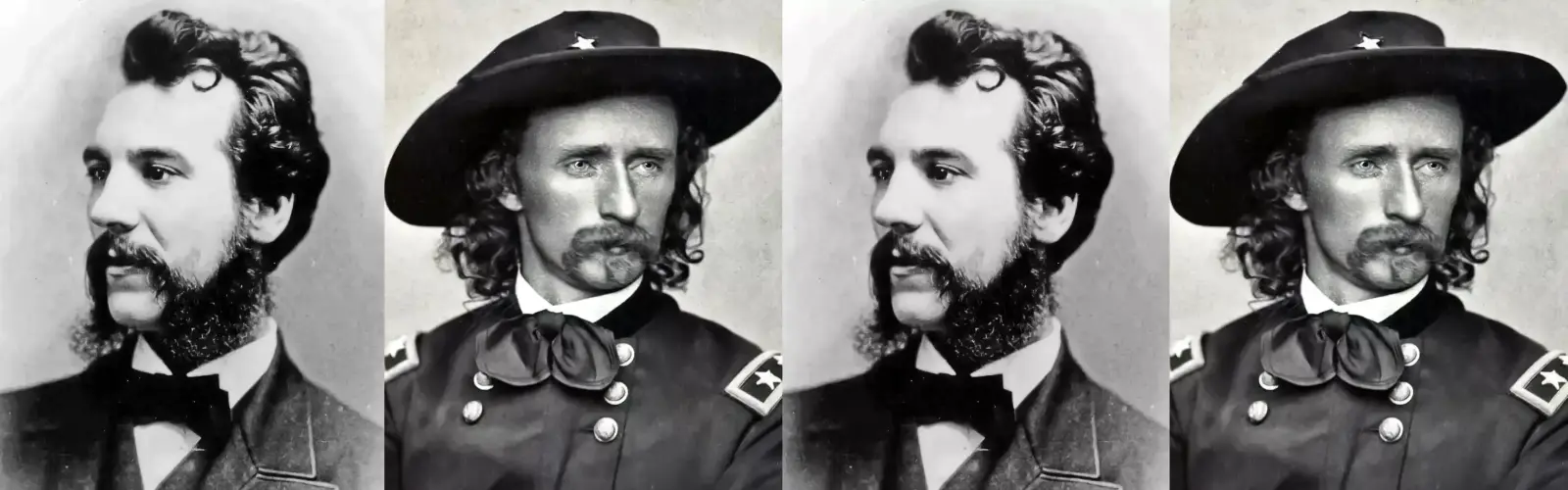
Bell and Custer – two men bent on the same ultimate aim. These portraits were taken in 1876.
If one has read Bell’s works such as ‘Memoir Upon the Formation of a Deaf Variety of the Human Race’ 1 one can see he was clearly focused on assimilation for the Deaf. He warned the growth of the ‘deaf race’ would pose terrible dangers for the world. So the Deaf too had to be assimilated. That by way of banning intermarriages, of prohibiting sign language, of forbidding deaf teachers to have jobs etc. No doubt Custer too thought the American Indian would pose a danger to the white man’s colonial desires, and that would be a terrible danger too.
It was clear those who could speak a dominant and powerful language – that being English, and did not use sign languages – were the new supremacist race. Its a majorly thing that still exists today, except many look the other way – like Bell and Custer once did.
Bell’s other work took quite a considerable prominence too. It would propel Bell’s riches and his fame. This would be a foundation upon which Bell could instruct his extraordinarily misconceived ideals. He would have an international reputation and many would see Bell as a hero because of the telephone – and that despite his distorted ideals which culminated in oralism, racism and eugenics. The Deaf person had to be taken down, the Black Person had to be taken down, and anyone else who did not fit Bell’s idea of a supremacist race, well they had to be taken down too.
Custer’s other work took quite a considerable prominence too. He wrote about the problems of the Wild West (but he could not see that it was the white man who had brought those problems – and not the American Indian). His literary work and military incursions would propel his fame. This would be a foundation upon which others could too pursue the misconceived ideals of assimilation and eugenics. That, despite Custer’s demise, resulted in a massive programme of assimilation for the American Indians. Another guy who desired to take down an indigenous people that had caused no trouble until the white man had decided their land was to be his instead.
Both guys put their best foot forward on the same fateful day in the United States. Alexander Graham Bell’s telephone was no doubt highly important in terms of his overall objectives, and as soon as he could, he began setting about giving the first ever official public demonstrations of the new device. By an odd quirk of fate, the first major public demonstration of the telephone in Philadelphia was also on the same day Custer and his 7th Cavalry were wiped out.
The date was 25th June 1876.

A one off special celebrating the older Sun newspaper which ceased publication in 1876. 2 Hence two momentous events on the same day. Image found on Ebay.
These historical events represent two different sides of the assimilation coin. On the one, those under a process of elimination had fought to kill one of the ideology’s main leaders. On the other, a new and rapidly emerging assimilation ideology was being promoted and everyone was embracing it. Its main leader was being seen as a hero. The difference at the time, even though few seem to have noticed, was the telephone accelerated the desire for the elimination of the Deaf. And the death of Custer enraged the white man – who, as a result, desired an even faster elimination for the American Indians.
Google AI was asked did Alexander Graham Bell and General Custer have an effect on each other? The following answer is given…
No, Alexander Graham Bell and General George Armstrong Custer did not directly influence each other, as they were involved in different fields and lived separate lives. Custer was a U.S. Army officer famous for his military career and demise at the Battle of Little Bighorn, while Bell was an inventor known for his creation of the telephone. The only commonality is that Bell’s telephone was unveiled on the same day Custer died in 1876, an event that marked a significant moment for both technology and American history.

That is very true, Bell and Custer had no influence on either. However that’s the perspective from what might be a skewered ideal which has largely come about because, well, its something that’s evidently not so easy for hearing people to work out. Custer dies on the same day Bell demonstrates his new telephone. Hmm… evidently on the one hand there was a Big Horn of one sort and on the other another Big Horn of another sort. That other ‘Big Horn’ would be the telephone device which consisted of a large horn device for people to speak into. The fall out from both would be that entire communities on both sides would face a considerable force intent on ensuring those communities’ assimilation into either what can be deemed the white race – or in another context – the hearing world.
One would think, well, that’s it, there’s nothing more to be said, we’ve now established both the white race and the hearing world are clearly supremacist entities.
Even so, its somewhat wrong to suggest Bell and Custer had no connection nor any influence on each other. There were indeed parallels between the two men. Bell wasn’t wanting to do what Custer and his ilk did, and Custer wasn’t wanting to do was Bell was intent on achieving. Nevertheless the winds of change subtly helped each other along. There was a euphoria in those days which deemed that any race or community of a considerably lesser status had to either level up – or disappear of the face of the Earth.
Just a couple of years or so after these momentous events of 1876, Plains Sign Language – which was in widespread use by the American Indians, was banned from 1879 onward. Following that, the Sign Languages used by the Deaf, was banned from 1880 onward.
When one considers one or the other, there was in fact a considerable force bent on eliminating those who did not use the approved verbal communication systems of the day. There was indeed an oralism for the American Indians just as there was for the Deaf. The former banned the use of both the native tongue and the native sign language. The latter banned the Deaf language and sought to impose a speech culture in education and everyday life.
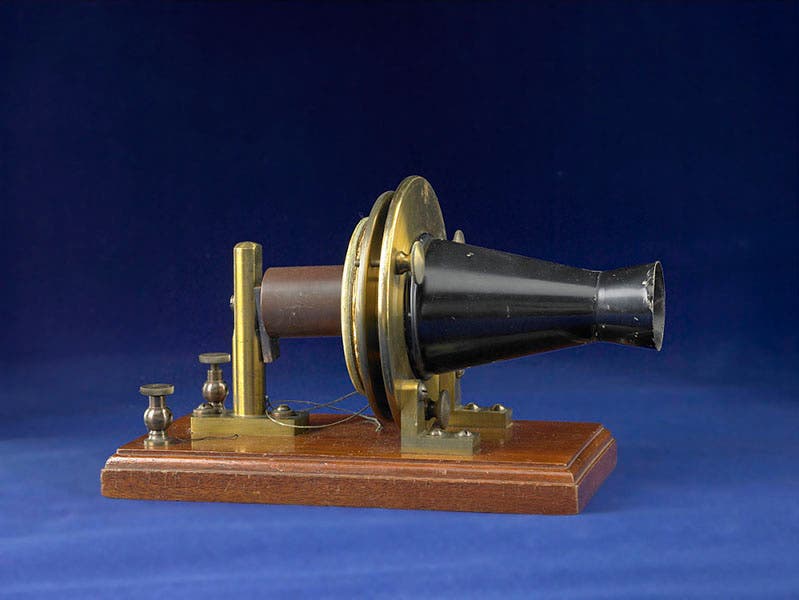
The telephone used on the day Custer’s last stand occurred. This device of Bell’s was demonstrated at the Centennial Exhibition in Philadelphia on 25 June 1876. Linda Hall Library.
Of course it wasn’t ‘oralism’ per se for the American Indian, but it was indeed a proto form of oralism because 1) Plains sign language was banned and 2) the Indians were expected to fully adopt the white man’s spoken tongue. If anyone cannot see the similarity in that and the doctrine of the type of oralism that Bell and his ilk promoted, perhaps its that more work needs to be done to highlight that. There is a good amount of history that illustrates this eventuality – and its a story that has so far been largely untold.
- Bell, A.G. (1884). Memoir upon the formation of a deaf variety of the human race. IDA@Gallaudet/Gallaudet University. Available at: https://ida.gallaudet.edu/deaf_rare_books/22/ [Accessed September. 2025]. ↩︎
- Wikipedia Contributors (2025). The Sun (1792–1876). Wikipedia. Available at: https://en.wikipedia.org/wiki/The_Sun_(1792–1876) [Accessed September 2025]. ↩︎